Suppose the position of an object moving horizontally along a line after t seconds is given by the following functions s = f(t), where s is measured in feet, with s > 0 corresponding to positions right of the origin. Determine the acceleration of the object when its velocity is zero. f(t) = 2t2 - 9t + 12; 0 ≤ t ≤ 3
Verified step by step guidance
1
Step 1: Find the velocity function by differentiating the position function s = f(t) with respect to time t. The velocity function v(t) is the first derivative of f(t), so v(t) = f'(t).
Step 2: Differentiate f(t) = 2t^2 - 9t + 12 to find v(t). Use the power rule for differentiation: if f(t) = at^n, then f'(t) = nat^(n-1).
Step 3: Set the velocity function v(t) equal to zero to find the time(s) when the velocity is zero. Solve the equation v(t) = 0 for t.
Step 4: Find the acceleration function by differentiating the velocity function v(t) with respect to time t. The acceleration function a(t) is the second derivative of f(t), so a(t) = v'(t) = f''(t).
Step 5: Evaluate the acceleration function a(t) at the time(s) found in Step 3 to determine the acceleration of the object when its velocity is zero.
Verified video answer for a similar problem:
This video solution was recommended by our tutors as helpful for the problem above
Video duration:
3m
Play a video:
0 Comments
Key Concepts
Here are the essential concepts you must grasp in order to answer the question correctly.
Position, Velocity, and Acceleration
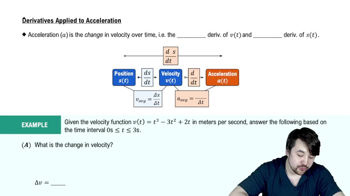
In calculus, the position function s = f(t) describes the location of an object over time. The velocity is the first derivative of the position function, indicating how fast the position changes with respect to time. Acceleration, the second derivative of the position function, measures how the velocity changes over time. Understanding these relationships is crucial for analyzing motion.
To determine when the velocity is zero, we need to find the critical points of the velocity function, which is derived from the position function. This involves setting the first derivative (velocity) equal to zero and solving for t. Critical points indicate where the object may change direction or stop, which is essential for analyzing motion.
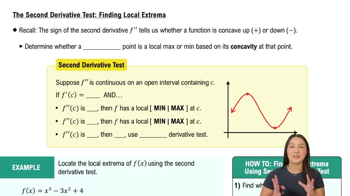
The second derivative test helps determine the nature of critical points found in the first derivative. By evaluating the second derivative at these points, we can ascertain whether the object is accelerating or decelerating. Specifically, if the second derivative is positive, the object is accelerating; if negative, it is decelerating. This is vital for understanding the object's motion when its velocity is zero.