Different axes of revolution Suppose R is the region bounded by y=f(x) and y=g(x) on the interval [a, b], where f(x)≥g(x).
b. How is this formula changed if x0>b?
Verified step by step guidance
1
Step 1: Understand the problem setup. The region R is bounded by two functions, y = f(x) and y = g(x), on the interval [a, b], where f(x) ≥ g(x). The formula for the volume of the solid of revolution depends on the axis of rotation and the interval of integration.
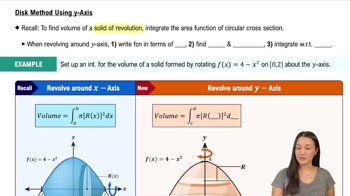
Step 2: Recall the formula for the volume of a solid of revolution. If the region is revolved around the x-axis, the volume is calculated using the formula: . This formula assumes the interval of integration is [a, b].
Step 3: Consider the case where x₀ > b. If the upper limit of integration changes to x₀, the interval of integration becomes [a, x₀]. The formula for the volume is updated accordingly: . This reflects the new upper limit of integration.
Step 4: Verify the conditions for the functions f(x) and g(x) over the interval [a, x₀]. Ensure that f(x) ≥ g(x) holds true for all x in [a, x₀]. If this condition is violated, the formula may need adjustment to account for the change in the relationship between the functions.
Step 5: Adjust the formula if the axis of rotation changes. If the region is revolved around a different axis (e.g., the y-axis or a line other than the x-axis), the formula for the volume will need to be modified to account for the new geometry. This involves using the appropriate radius of rotation and updating the integral accordingly.
Verified video answer for a similar problem:
This video solution was recommended by our tutors as helpful for the problem above
Video duration:
2m
Play a video:
0 Comments
Key Concepts
Here are the essential concepts you must grasp in order to answer the question correctly.
Volume of Revolution
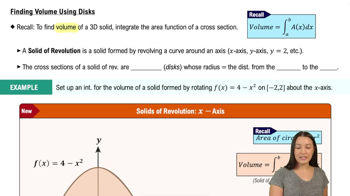
The volume of revolution refers to the volume generated when a region in the plane is rotated around a specified axis. This is typically calculated using methods such as the disk method or the washer method, which involve integrating the area of circular cross-sections perpendicular to the axis of rotation. Understanding this concept is crucial for solving problems related to the volume of regions bounded by functions.
Definite integrals are used to calculate the area under a curve between two points on the x-axis. In the context of volume of revolution, they help determine the total volume by integrating the area of cross-sections over the interval [a, b]. Mastery of definite integrals is essential for applying the formulas correctly and understanding how changes in the limits of integration affect the result.
The axis of revolution is the line around which a region is rotated to create a three-dimensional solid. The choice of axis (e.g., x-axis, y-axis, or a vertical line) significantly influences the volume calculation. When the axis of revolution is outside the bounds of the region, as indicated by x0 > b, the formula for volume must be adjusted to account for the new limits and the geometry of the resulting solid.