Exponential growth rates a. For what values of b > 0 does bˣ grow faster than eˣ as x→∞?
Verified step by step guidance
1
To determine for which values of b > 0 the function bˣ grows faster than eˣ as x approaches infinity, we need to compare the growth rates of these two functions.
Consider the ratio of the two functions: (bˣ)/(eˣ). We want to find the values of b for which this ratio approaches infinity as x approaches infinity.
Rewrite the ratio using properties of exponents: (bˣ)/(eˣ) = (b/e)ˣ.
For (b/e)ˣ to grow faster than eˣ, the base (b/e) must be greater than 1. This is because if the base of an exponential function is greater than 1, the function grows exponentially as x increases.
Therefore, for bˣ to grow faster than eˣ, b/e > 1, which implies b > e. Thus, b must be greater than the mathematical constant e (approximately 2.718).
Verified video answer for a similar problem:

This video solution was recommended by our tutors as helpful for the problem above
Video duration:
6m
Play a video:
0 Comments
Key Concepts
Here are the essential concepts you must grasp in order to answer the question correctly.
Exponential Functions
Exponential functions are mathematical expressions of the form f(x) = b^x, where b is a positive constant. These functions exhibit rapid growth as x increases, with the base b determining the rate of growth. For example, if b = 2, the function grows faster than linear functions but slower than higher exponential bases.
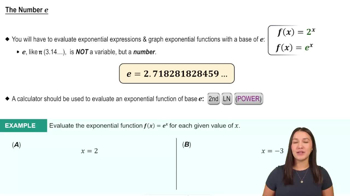
The number e, approximately equal to 2.718, is a fundamental constant in mathematics, particularly in calculus. It serves as the base for natural logarithms and is significant in modeling continuous growth processes. The function e^x is unique because it is the only function that is its own derivative, making it a critical point of comparison for other exponential functions.
To compare the growth rates of two exponential functions, we analyze their limits as x approaches infinity. Specifically, we can determine when b^x grows faster than e^x by examining the ratio of the two functions. If the limit of (b^x)/(e^x) approaches infinity as x increases, then b^x grows faster than e^x, which occurs when b > e.