Find the following limits or state that they do not exist. Assume a, b , c, and k are fixed real numbers.
lim x→2 (5x−6)^3/2
Verified step by step guidance
1
Identify the type of limit problem: This is a direct substitution problem where we need to find the limit of a function as x approaches a specific value.
Recognize the function: The function given is \((5x - 6)^{3/2}\).
Apply direct substitution: Substitute \(x = 2\) into the function to evaluate the limit.
Calculate the expression inside the function: Compute \(5(2) - 6\) to simplify the expression inside the power.
Evaluate the power: Once the expression inside the function is simplified, raise it to the power of \(\frac{3}{2}\) to find the limit.
Verified video answer for a similar problem:

This video solution was recommended by our tutors as helpful for the problem above
Video duration:
1m
Play a video:
0 Comments
Key Concepts
Here are the essential concepts you must grasp in order to answer the question correctly.
Limits
A limit is a fundamental concept in calculus that describes the behavior of a function as its input approaches a certain value. It helps in understanding how functions behave near specific points, which is crucial for evaluating continuity and differentiability. In this case, we are interested in the limit of the function as x approaches 2.
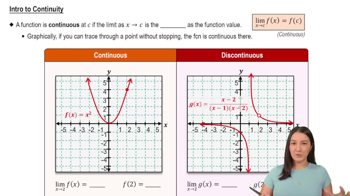
A function is continuous at a point if the limit of the function as it approaches that point equals the function's value at that point. For the limit to exist, the function must not have any breaks, jumps, or asymptotes at the point of interest. The expression (5x−6) is a polynomial, which is continuous everywhere, including at x = 2.
When evaluating limits of composite functions, such as (5x−6) raised to the power of 3/2, it is essential to first find the limit of the inner function before applying the outer function. This process often involves substituting the limit value into the inner function and then applying the outer function to that result, ensuring that the operations are valid within the domain of the functions involved.