In Exercises 1–10, find the extreme values (absolute and local) of the function over its natural domain, and where they occur. ______ y = √𝓍² ― 1
Verified step by step guidance
1
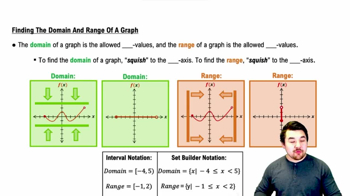
Identify the natural domain of the function y = √(x² - 1). The expression under the square root, x² - 1, must be greater than or equal to zero for y to be real. Solve the inequality x² - 1 ≥ 0 to find the domain.
Solve the inequality x² - 1 ≥ 0. This can be rewritten as x² ≥ 1, which implies x ≤ -1 or x ≥ 1. Therefore, the natural domain of the function is x ∈ (-∞, -1] ∪ [1, ∞).
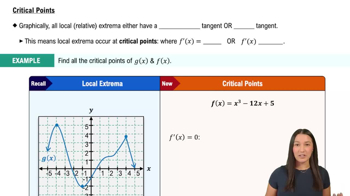
Find the critical points by taking the derivative of the function. The derivative of y = √(x² - 1) is y' = (1/2)(x² - 1)^(-1/2) * 2x = x / √(x² - 1). Set y' = 0 to find critical points.
Solve the equation x / √(x² - 1) = 0. This implies x = 0. However, x = 0 is not in the domain of the function, so there are no critical points within the domain.
Evaluate the function at the endpoints of the domain, x = -1 and x = 1, to find the extreme values. Calculate y(-1) and y(1) to determine the absolute minimum and maximum values of the function over its natural domain.
Verified video answer for a similar problem:
This video solution was recommended by our tutors as helpful for the problem above
Video duration:
8m
Play a video:
0 Comments
Key Concepts
Here are the essential concepts you must grasp in order to answer the question correctly.
Extreme Values
Extreme values refer to the maximum and minimum values of a function within a given domain. Absolute extreme values are the highest and lowest points over the entire domain, while local extreme values are the highest or lowest points within a specific interval. Identifying these values often involves analyzing the function's critical points and endpoints.
Critical points are values in the domain of a function where the derivative is either zero or undefined. These points are essential for finding local extrema, as they indicate where the function's slope changes, potentially leading to local maxima or minima. To find critical points, one typically takes the derivative of the function and solves for when it equals zero.
The natural domain of a function is the set of all possible input values (x-values) for which the function is defined. For the function y = √(x² - 1), the natural domain is determined by ensuring the expression under the square root is non-negative, leading to the condition x² - 1 ≥ 0. This results in the domain being x ≤ -1 or x ≥ 1.

 8:19 minutes
 Verified step by step guidance
 06:37
06:37