Evaluate and simplify the difference quotients (f(x + h) - f(x)) / h and (f(x) - f(a)) / (x - a) for each function. f(x) = 7 / (x + 3)
Verified step by step guidance
1
Step 1: Identify the function f(x) = \(\frac{7}{x + 3}\).
Step 2: For the first difference quotient, calculate f(x + h) by substituting x + h into the function: f(x + h) = \(\frac{7}{(x + h) + 3}\).
Step 3: Substitute f(x + h) and f(x) into the first difference quotient: \(\frac{f(x + h) - f(x)}{h}\) = \(\frac{\frac{7}{x + h + 3}\) - \(\frac{7}{x + 3}\)}{h}.
Step 4: Simplify the expression from Step 3 by finding a common denominator for the fractions in the numerator: \(\frac{7(x + 3) - 7(x + h + 3)}{h(x + h + 3)(x + 3)}\).
Step 5: For the second difference quotient, calculate f(a) by substituting a into the function: f(a) = \(\frac{7}{a + 3}\), and then substitute f(x) and f(a) into the second difference quotient: \(\frac{f(x) - f(a)}{x - a}\) = \(\frac{\frac{7}{x + 3}\) - \(\frac{7}{a + 3}\)}{x - a}.
Verified video answer for a similar problem:
This video solution was recommended by our tutors as helpful for the problem above
Video duration:
5m
Play a video:
0 Comments
Key Concepts
Here are the essential concepts you must grasp in order to answer the question correctly.
Difference Quotient
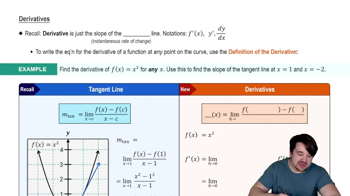
The difference quotient is a fundamental concept in calculus that represents the average rate of change of a function over an interval. It is defined as (f(x + h) - f(x)) / h, where h is a small increment. This expression is crucial for understanding the derivative, as it approaches the instantaneous rate of change as h approaches zero.
The limit is a core concept in calculus that describes the behavior of a function as its input approaches a certain value. In the context of the difference quotient, taking the limit as h approaches zero allows us to find the derivative of a function. Limits help in analyzing the continuity and behavior of functions at specific points.
The derivative of a function measures how the function's output changes as its input changes, representing the function's instantaneous rate of change. It is defined as the limit of the difference quotient as h approaches zero. Derivatives are essential for understanding the behavior of functions, including their slopes, tangents, and optimization problems.

 5:14 minutes
 Verified step by step guidance
 06:43
06:43