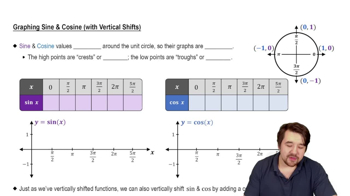
Step 1: Recognize that the limit \( \lim_{x \to 0} \frac{\sin x}{x} \) is a fundamental limit in calculus, often used in the study of derivatives and integrals involving trigonometric functions.
Step 2: Understand that this limit evaluates to 1, which is crucial for solving problems involving small angle approximations and for finding derivatives of trigonometric functions.
Step 3: Apply this limit when dealing with expressions that can be rewritten in the form \( \frac{\sin x}{x} \) as \( x \to 0 \). This often involves algebraic manipulation to match the form.
Step 4: Use this limit to derive the derivative of \( \sin x \), which is \( \cos x \), by considering the definition of the derivative and applying the limit.
Step 5: Recognize that this limit is also used in L'Hôpital's Rule, which helps evaluate indeterminate forms like \( \frac{0}{0} \) by differentiating the numerator and the denominator.
Verified video answer for a similar problem:
This video solution was recommended by our tutors as helpful for the problem above
Video duration:
2m
Play a video:
0 Comments
Key Concepts
Here are the essential concepts you must grasp in order to answer the question correctly.
Limit of a Function
The limit of a function describes the value that a function approaches as the input approaches a certain point. In calculus, limits are fundamental for defining continuity, derivatives, and integrals. The expression lim x→0 sin x/x is a classic limit that evaluates the behavior of the sine function as x approaches zero, which is crucial for understanding the function's properties near that point.
The sine function, denoted as sin(x), is a periodic function that oscillates between -1 and 1. Its behavior near zero is particularly important in calculus, as it helps in approximating values and understanding the function's growth. The limit lim x→0 sin x/x reveals that as x approaches zero, the ratio approaches 1, illustrating the relationship between the sine function and linear approximations.
L'Hôpital's Rule is a method for evaluating limits of indeterminate forms, such as 0/0 or ∞/∞. When faced with such forms, the rule states that the limit of the ratio of two functions can be found by taking the derivative of the numerator and the derivative of the denominator. This rule can be applied to the limit lim x→0 sin x/x, confirming that the limit equals 1 by differentiating both the numerator and denominator.

 2:24 minutes
 Verified step by step guidance
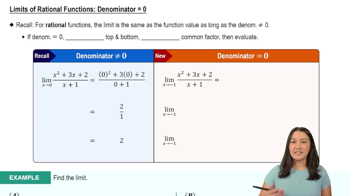
 06:11
06:11