11-14. {Use of Tech} Compute the absolute and relative errors in using c to approximate x. 12. x = √2; c = 1.414
Verified step by step guidance
1
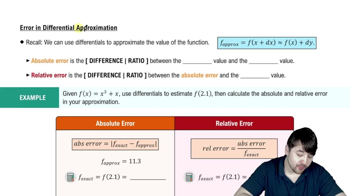
Step 1: Understand the problem. You are tasked with calculating the absolute and relative errors when using the approximation c = 1.414 for the exact value x = √2. Absolute error measures the difference between the exact value and the approximation, while relative error measures the absolute error relative to the exact value.
Step 2: Write the formula for absolute error. The absolute error is given by: . Substitute x = √2 and c = 1.414 into this formula.
Step 3: Write the formula for relative error. The relative error is given by: . Again, substitute x = √2 and c = 1.414 into this formula.
Step 4: Compute the value of √2. Recall that √2 is an irrational number approximately equal to 1.41421356. Use this value for x in the formulas for absolute and relative errors.
Step 5: Perform the subtraction and division operations as required by the formulas. For absolute error, calculate . For relative error, divide the absolute error by . These steps will yield the absolute and relative errors.
Verified video answer for a similar problem:
This video solution was recommended by our tutors as helpful for the problem above
Video duration:
1m
Play a video:
0 Comments
Key Concepts
Here are the essential concepts you must grasp in order to answer the question correctly.
Absolute Error
Absolute error measures the difference between the true value and the approximate value. It is calculated as the absolute value of the difference: |true value - approximate value|. In this case, the true value is √2, and the approximate value is c (1.414). This concept helps quantify how close the approximation is to the actual value.
Relative error provides a measure of the size of the absolute error in relation to the true value. It is calculated by dividing the absolute error by the true value, often expressed as a percentage: (absolute error / true value) × 100%. This concept is useful for understanding the accuracy of an approximation in a relative context, especially when dealing with different scales.
An approximation is a value or expression that is close to, but not exactly equal to, a true value. In calculus and numerical analysis, approximations are often used to simplify complex calculations or to estimate values that are difficult to compute exactly. Understanding how to evaluate the quality of an approximation, through absolute and relative errors, is essential for assessing its usefulness in practical applications.

 1:57 minutes
 Verified step by step guidance
 04:57
04:57