The general solution of a first-order linear differential equation is y(t) = Ce⁻¹⁰ᵗ − 13. What solution satisfies the initial condition y(0) = 4?
Verified step by step guidance
1
Identify the general solution given: \(y(t) = Ce^{-10t} - 13\).
Apply the initial condition \(y(0) = 4\) by substituting \(t = 0\) into the general solution: \(y(0) = Ce^{-10 \cdot 0} - 13\).
Simplify the expression using the fact that \(e^0 = 1\), so it becomes \(y(0) = C - 13\).
Set the simplified expression equal to the initial condition value: \(C - 13 = 4\).
Solve the equation for \(C\) to find the particular solution constant.
Verified video answer for a similar problem:
This video solution was recommended by our tutors as helpful for the problem above
Video duration:
1m
Play a video:
0 Comments
Key Concepts
Here are the essential concepts you must grasp in order to answer the question correctly.
First-Order Linear Differential Equations
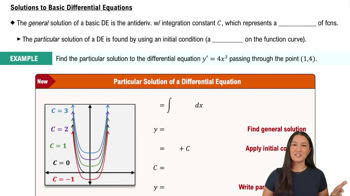
These are differential equations of the form dy/dt + p(t)y = q(t), where the solution involves integrating factors or direct integration. The general solution typically includes an arbitrary constant representing a family of solutions.
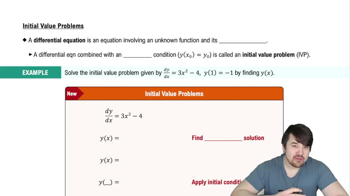
An initial condition specifies the value of the solution at a particular point, such as y(0) = 4. It allows us to find the specific constant in the general solution, yielding a unique solution that fits the given condition.
To apply the initial condition, substitute the given value of t into the general solution and solve for the constant C. This process ensures the solution satisfies both the differential equation and the initial condition.