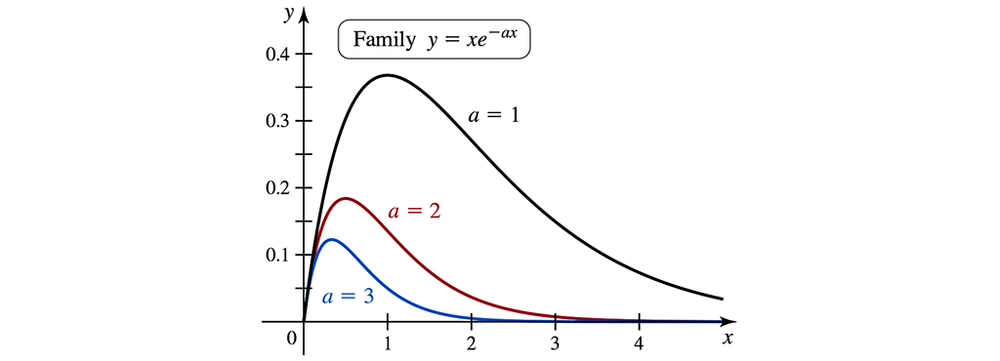
82. A family of exponentials The curves y = x * e^(-a * x) are shown in the figure for a = 1, 2, and 3. c. Find the area of the region bounded by y = x * e^(-a * x) and the x-axis on the interval [0, b]. Because this area depends on a and b, we call it A(a, b).
Verified step by step guidance
1
Identify the function and the interval for the area calculation. The function is given by \(y = x e^{-a x}\), and the area \(A(a, b)\) is the integral of this function from \$0\( to \)b$.
Set up the definite integral to find the area under the curve and above the x-axis on the interval \([0, b]\):
\(A(a, b) = \int_0^b x e^{-a x} \, dx\)
To solve the integral, use integration by parts. Let \(u = x\) and \(dv = e^{-a x} dx\). Then, compute \(du = dx\) and find \(v\) by integrating \(dv\):
\(v = \int e^{-a x} dx = -\frac{1}{a} e^{-a x}\)
Apply the integration by parts formula:
\(\int u \, dv = uv - \int v \, du\), which gives
\(\int_0^b x e^{-a x} dx = \left. -\frac{x}{a} e^{-a x} \right|_0^b + \frac{1}{a} \int_0^b e^{-a x} dx\)
Evaluate the remaining integral \(\int_0^b e^{-a x} dx\) and then substitute the limits \$0\( and \)b\( into the expression to write \)A(a, b)\( explicitly in terms of \)a\( and \)b$.
Verified video answer for a similar problem:

This video solution was recommended by our tutors as helpful for the problem above
Video duration:
6m
Play a video:
0 Comments
Key Concepts
Here are the essential concepts you must grasp in order to answer the question correctly.
Definite Integral and Area Under a Curve
The definite integral of a function over an interval [0, b] represents the area under the curve between those points. For the function y = x * e^(-a * x), integrating from 0 to b calculates the area bounded by the curve and the x-axis, which depends on both parameters a and b.
Integrating functions involving exponentials like e^(-a * x) often requires techniques such as integration by parts. Since y = x * e^(-a * x) is a product of x and an exponential, applying integration by parts helps to find an explicit formula for the integral and thus the area A(a, b).
The parameter 'a' in y = x * e^(-a * x) affects the shape and decay rate of the curve. Understanding how the integral (area) changes with 'a' and the upper limit 'b' is crucial for analyzing the family of curves and how the bounded area varies with these parameters.