to find the power series representation for the following functions (centered at 0). Give the interval of convergence of the new series.
f(x³) = 1/(1 − x³)
Verified step by step guidance
1
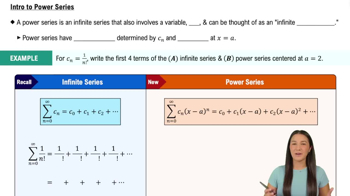
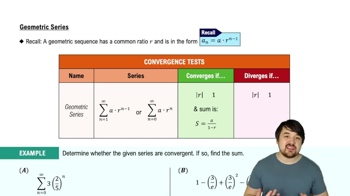
Recall the geometric series formula: \(f(x) = \frac{1}{1 - x} = \sum_{k=0}^{\infty} x^{k}\) for \(|x| < 1\).
To find the power series for \(f(x^{3}) = \frac{1}{1 - x^{3}}\), substitute \(x^{3}\) in place of \(x\) in the original series.
This gives \(f(x^{3}) = \sum_{k=0}^{\infty} (x^{3})^{k} = \sum_{k=0}^{\infty} x^{3k}\).
The power series representation is therefore \(\sum_{k=0}^{\infty} x^{3k}\), which is centered at 0.
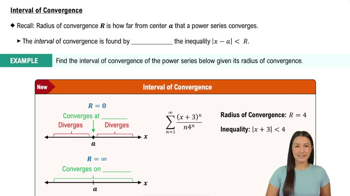
Determine the interval of convergence by applying the original condition \(|x| < 1\) to the new variable: since the series is in terms of \(x^{3}\), the condition becomes \(|x^{3}| < 1\), which simplifies to \(|x| < 1\).
Verified video answer for a similar problem:
This video solution was recommended by our tutors as helpful for the problem above
Video duration:
3m
Play a video:
0 Comments
Key Concepts
Here are the essential concepts you must grasp in order to answer the question correctly.
Geometric Series and Its Power Series Representation
A geometric series is a sum of the form ∑ x^k for k from 0 to infinity, which converges to 1/(1-x) when |x| < 1. This fundamental series allows us to express functions as infinite sums, facilitating manipulation and analysis of functions within their radius of convergence.
Substitution involves replacing the variable x in a known power series with another expression, such as x³. This transforms the original series into a new series representing a related function, while maintaining the structure of the series and adjusting the interval of convergence accordingly.
The interval of convergence is the set of x-values for which a power series converges. When substituting variables, the interval changes based on the new expression's magnitude. Determining this interval ensures the validity of the power series representation for the function.