{Use of Tech} Logistic equation for an epidemic When an infected person is introduced into a closed and otherwise healthy community, the number of people who contract the disease (in the absence of any intervention) may be modeled by the logistic equation dP/dt=kP(1−P/A),P0=P_0, where K is a positive infection rate, A is the number of people in the community, and P0 is the number of infected people at t=0. The model also assumes no recovery. a. Find the solution of the initial value problem, for t≥0, in terms of K, A, and P0.
Verified step by step guidance
1
Recognize that the given differential equation is a logistic differential equation of the form \(\frac{dP}{dt} = kP\left(1 - \frac{P}{A}\right)\), where \(k\) and \(A\) are constants, and \(P(t)\) is the function to solve for with initial condition \(P(0) = P_0\).
Rewrite the equation to separate variables: \(\frac{dP}{P(1 - \frac{P}{A})} = k \, dt\). This allows us to integrate both sides with respect to their variables.
Simplify the left side by expressing the denominator as \(P\left(1 - \frac{P}{A}\right) = P \left(\frac{A - P}{A}\right) = \frac{P(A - P)}{A}\). Then, rewrite the integral as \(\int \frac{A}{P(A - P)} \, dP = \int k \, dt\).
Use partial fraction decomposition to break down \(\frac{A}{P(A - P)}\) into simpler fractions: \(\frac{A}{P(A - P)} = \frac{C}{P} + \frac{D}{A - P}\). Find constants \(C\) and \(D\) by equating numerators.
Integrate both sides: \(\int \left(\frac{C}{P} + \frac{D}{A - P}\right) dP = \int k \, dt\). After integration, solve for \(P(t)\) explicitly, applying the initial condition \(P(0) = P_0\) to find the constant of integration.
Verified video answer for a similar problem:
This video solution was recommended by our tutors as helpful for the problem above
Video duration:
8m
Play a video:
0 Comments
Key Concepts
Here are the essential concepts you must grasp in order to answer the question correctly.
Logistic Differential Equation
The logistic differential equation models population growth with a carrying capacity, expressed as dP/dt = kP(1 - P/A). Here, P(t) is the population at time t, k is the growth rate, and A is the maximum population limit. It captures initial exponential growth that slows as P approaches A.
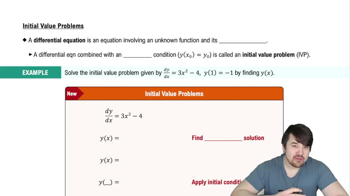
An initial value problem involves solving a differential equation with a given initial condition, such as P(0) = P0. This condition allows determination of the specific solution curve that fits the starting state of the system, ensuring a unique solution.
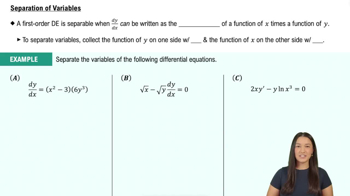
Separation of variables is a technique to solve differential equations by rewriting them so that all terms involving P are on one side and all terms involving t on the other. Integrating both sides then yields an implicit or explicit solution for P(t).