A triangle has side c = 2 and angles A = π/4 and B = π/3. Find the length a of the side opposite A.
Verified step by step guidance
1
First, recognize that you are dealing with a triangle where you know two angles and one side. This is a case for the Law of Sines, which relates the sides of a triangle to the sines of its angles.
The Law of Sines states: \( \frac{a}{\sin A} = \frac{b}{\sin B} = \frac{c}{\sin C} \). In this problem, you need to find side 'a', and you know side 'c' and angles A and B.
Calculate the third angle C using the fact that the sum of angles in a triangle is \( \pi \) radians. So, \( C = \pi - A - B \). Substitute \( A = \frac{\pi}{4} \) and \( B = \frac{\pi}{3} \) to find \( C \).
Now, apply the Law of Sines: \( \frac{a}{\sin A} = \frac{c}{\sin C} \). Substitute the known values: \( c = 2 \), \( A = \frac{\pi}{4} \), and the calculated \( C \).
Solve for 'a' by rearranging the equation: \( a = c \cdot \frac{\sin A}{\sin C} \). Substitute the values and calculate the sine of the angles to find the length of side 'a'.
Verified video answer for a similar problem:
This video solution was recommended by our tutors as helpful for the problem above
Video duration:
2m
Play a video:
0 Comments
Key Concepts
Here are the essential concepts you must grasp in order to answer the question correctly.
Law of Sines
The Law of Sines states that the ratio of the length of a side of a triangle to the sine of its opposite angle is constant for all three sides and angles. This relationship can be expressed as a/sin(A) = b/sin(B) = c/sin(C). In this problem, it allows us to find the unknown side 'a' by relating it to the known side 'c' and the angles A and B.
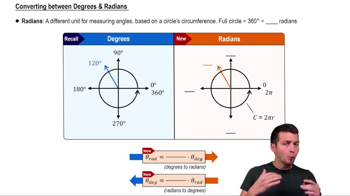
In calculus and trigonometry, angles can be measured in degrees or radians. Radians are a more natural unit for mathematical analysis, where π radians equals 180 degrees. Understanding how to convert between these two systems is crucial, especially since the angles given in the problem are in radians, which will be used in the sine function calculations.
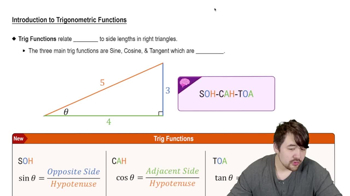
Trigonometric functions, such as sine, cosine, and tangent, relate the angles of a triangle to the ratios of its sides. The sine function, in particular, is essential for solving triangles, as it provides a way to calculate unknown side lengths when angles are known. In this problem, we will use the sine of angles A and B to find the length of side 'a' opposite angle A.

 2:44 minutes
 Verified step by step guidance
 4:03
4:03