96. Challenge Show that with the change of variables u = √tan x, the integral ∫ √tan x dx can be converted to an integral amenable to partial fractions. Evaluate ∫[0 to π/4] √tan x dx.
Verified step by step guidance
1
Start with the substitution given: let \( u = \sqrt{\tan x} \). This means \( u^2 = \tan x \).
Differentiate both sides with respect to \( x \) to find \( du \) in terms of \( dx \): \( \frac{d}{dx}(u^2) = \frac{d}{dx}(\tan x) \) which gives \( 2u \frac{du}{dx} = \sec^2 x \). Solve for \( dx \) in terms of \( du \) and \( u \).
Express \( \sec^2 x \) in terms of \( u \) using the identity \( \tan^2 x + 1 = \sec^2 x \). Since \( \tan x = u^2 \), then \( \sec^2 x = 1 + u^4 \).
Rewrite the integral \( \int \sqrt{\tan x} \, dx = \int u \, dx \) by substituting \( dx \) from step 2 and \( \sec^2 x \) from step 3, to get the integral entirely in terms of \( u \) and \( du \).
Simplify the resulting integral to a rational function in \( u \) that can be decomposed into partial fractions. Then set up the partial fraction decomposition to prepare for integration.
Verified video answer for a similar problem:
This video solution was recommended by our tutors as helpful for the problem above
Video duration:
2m
Play a video:
0 Comments
Key Concepts
Here are the essential concepts you must grasp in order to answer the question correctly.
Change of Variables (Substitution)
This technique involves replacing the original variable with a new one to simplify the integral. By expressing the integral in terms of a new variable, complex expressions can become easier to handle, often transforming the integral into a more familiar or solvable form.
Partial fractions break down a complex rational function into simpler fractions that are easier to integrate. This method is especially useful when the integrand is a rational expression, allowing the integral to be expressed as a sum of simpler terms.
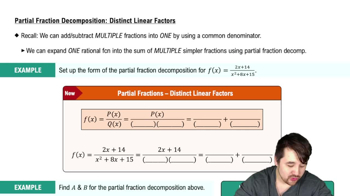
Partial Fraction Decomposition: Distinct Linear Factors
Definite Integration with Trigonometric Limits
Evaluating definite integrals involving trigonometric functions requires careful substitution and adjustment of limits. When changing variables, the limits must be transformed accordingly to maintain the integral's value over the specified interval.

 2:55 minutes
 Verified step by step guidance
 04:27
04:27