Notice that direct substitution of \( p = 2 \) results in an indeterminate form \( \frac{0}{0} \).
To resolve the indeterminate form, multiply the numerator and the denominator by the conjugate of the denominator: \( \sqrt{4p + 1} + 1 \).
This will transform the expression into: \( \lim_{{p \to 2}} \frac{3p(\sqrt{4p + 1} + 1)}{(\sqrt{4p + 1} - 1)(\sqrt{4p + 1} + 1)} \).
Simplify the denominator using the difference of squares: \( (\sqrt{4p + 1})^2 - 1^2 = 4p + 1 - 1 = 4p \).
Verified video answer for a similar problem:
This video solution was recommended by our tutors as helpful for the problem above
Video duration:
1m
Play a video:
Was this helpful?
Key Concepts
Here are the essential concepts you must grasp in order to answer the question correctly.
Limits
A limit is a fundamental concept in calculus that describes the behavior of a function as its input approaches a certain value. It helps in understanding how functions behave near specific points, which is crucial for evaluating continuity and differentiability. In this question, we are tasked with finding the limit of a function as p approaches 2.
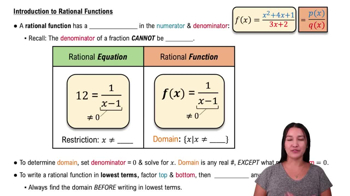
Rational functions are expressions formed by the ratio of two polynomials. They can exhibit various behaviors, such as approaching infinity or having holes, depending on the values of the variables involved. In the limit expression given, the function involves a rational expression, which requires careful analysis to determine its limit as p approaches 2.
Indeterminate forms occur in calculus when evaluating limits leads to expressions like 0/0 or ∞/∞, which do not provide clear information about the limit's value. In such cases, techniques like L'Hôpital's Rule or algebraic manipulation are often employed to resolve these forms. The limit in the question may present an indeterminate form, necessitating further analysis to find its value.