Explain why or why not Determine whether the following statements are true and give an explanation or counterexample.
c. The parametric equations x=t, y=t², for t≥0, describe the complete parabola y=x².
Verified step by step guidance
1
Identify the given parametric equations: \(x = t\) and \(y = t^{2}\), with the parameter constraint \(t \geq 0\).
Recall that the parabola \(y = x^{2}\) includes all points where \(y\) is the square of \(x\), for all real values of \(x\).
Analyze the range of \(x\) values generated by the parametric equations: since \(x = t\) and \(t \geq 0\), \(x\) only takes non-negative values (i.e., \(x \geq 0\)).
Check if the parametric equations cover the entire parabola: the parabola \(y = x^{2}\) extends for all real \(x\), including negative values, but the parametric form only covers \(x \geq 0\).
Conclude that the parametric equations describe only the right half (where \(x \geq 0\)) of the parabola \(y = x^{2}\), not the complete parabola.
Verified video answer for a similar problem:
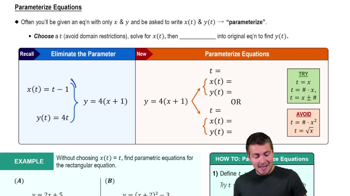
This video solution was recommended by our tutors as helpful for the problem above
Video duration:
3m
Play a video:
0 Comments
Key Concepts
Here are the essential concepts you must grasp in order to answer the question correctly.
Parametric Equations
Parametric equations express the coordinates of points on a curve as functions of a parameter, often denoted t. Instead of y as a function of x, both x and y depend on t, allowing the description of more general curves and motions.
The domain of the parameter t restricts which points on the curve are traced. For example, if t ≥ 0, only points corresponding to nonnegative t values are included, which may represent only part of the full curve.
The parabola y = x² includes all points where y equals the square of x, for all real x. To describe the complete parabola parametrically, the parameter must cover all real x values, not just nonnegative ones.