Locating critical points Find the critical points of the following functions. Assume a is a nonzero constant.
ƒ(x) = x² √(x + 5)
Verified step by step guidance
1
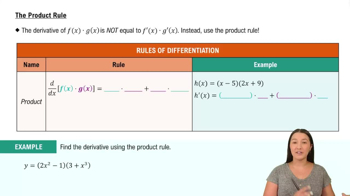
To find the critical points of the function ƒ(x) = x² √(x + 5), we first need to find its derivative. Use the product rule for differentiation, since the function is a product of x² and √(x + 5).
The product rule states that if you have two functions u(x) and v(x), then the derivative of their product is u'(x)v(x) + u(x)v'(x). Here, let u(x) = x² and v(x) = √(x + 5).
Differentiate u(x) = x² to get u'(x) = 2x. Differentiate v(x) = √(x + 5) using the chain rule: v'(x) = (1/2)(x + 5)^(-1/2) * 1 = 1/(2√(x + 5)).
Apply the product rule: ƒ'(x) = 2x√(x + 5) + x²/(2√(x + 5)). Simplify the expression to make it easier to analyze.
Set ƒ'(x) = 0 to find the critical points. Solve the equation 2x√(x + 5) + x²/(2√(x + 5)) = 0 for x, considering the domain restrictions where x + 5 > 0.
Verified video answer for a similar problem:
This video solution was recommended by our tutors as helpful for the problem above
Video duration:
6m
Play a video:
0 Comments
Key Concepts
Here are the essential concepts you must grasp in order to answer the question correctly.
Critical Points
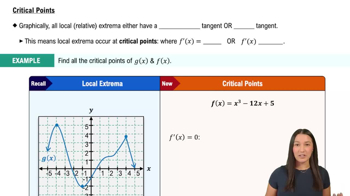
Critical points of a function occur where its derivative is either zero or undefined. These points are essential for identifying local maxima, minima, and points of inflection. To find critical points, one typically differentiates the function and solves for the values of x that satisfy these conditions.
The derivative of a function measures the rate at which the function's value changes with respect to changes in its input. It is a fundamental concept in calculus, providing insights into the function's behavior, such as increasing or decreasing intervals. For the function given, applying the product and chain rules will be necessary to find its derivative.
The product rule is a formula used to differentiate products of two functions. It states that if you have two functions u(x) and v(x), the derivative of their product is given by u'v + uv'. This rule is particularly relevant for the function in the question, as it involves the product of x² and √(x + 5).