Step 1: Begin by identifying the function y = \(\frac{2\sqrt{x}\)}{3(1 + \(\sqrt{x}\))}. This is a rational function where both the numerator and the denominator involve square roots.
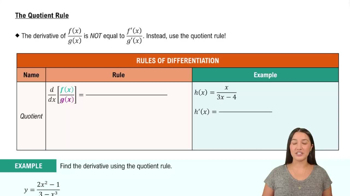
Step 2: Apply the quotient rule for derivatives, which states that if you have a function y = \(\frac{u(x)}{v(x)}\), then the derivative dy/dx is given by \(\frac{u'(x)v(x) - u(x)v'(x)}{(v(x))^2}\). Here, u(x) = 2\(\sqrt{x}\) and v(x) = 3(1 + \(\sqrt{x}\)).
Step 3: Find the derivative of the numerator u(x) = 2\(\sqrt{x}\). The derivative u'(x) can be found using the chain rule. Recall that \(\sqrt{x}\) = x^{1/2}, so u'(x) = 2 \(\cdot\) \(\frac{1}{2}\)x^{-1/2} = x^{-1/2}.
Step 4: Find the derivative of the denominator v(x) = 3(1 + \(\sqrt{x}\)). The derivative v'(x) involves differentiating 1 + \(\sqrt{x}\). The derivative of \(\sqrt{x}\) is \(\frac{1}{2}\)x^{-1/2}, so v'(x) = 3 \(\cdot\) \(\frac{1}{2}\)x^{-1/2} = \(\frac{3}{2}\)x^{-1/2}.
Step 5: Substitute u(x), u'(x), v(x), and v'(x) into the quotient rule formula: dy/dx = \(\frac{x^{-1/2}\) \(\cdot\) 3(1 + \(\sqrt{x}\)) - 2\(\sqrt{x}\) \(\cdot\) \(\frac{3}{2}\)x^{-1/2}}{(3(1 + \(\sqrt{x}\)))^2}. Simplify the expression to find the derivative dy/dx.
Verified video answer for a similar problem:
This video solution was recommended by our tutors as helpful for the problem above
Video duration:
5m
Play a video:
0 Comments
Key Concepts
Here are the essential concepts you must grasp in order to answer the question correctly.
Derivatives
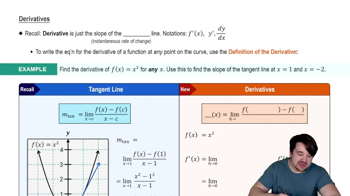
A derivative represents the rate of change of a function with respect to its variable. It is a fundamental concept in calculus that allows us to determine how a function behaves at any given point. The derivative can be interpreted as the slope of the tangent line to the curve of the function at a specific point.
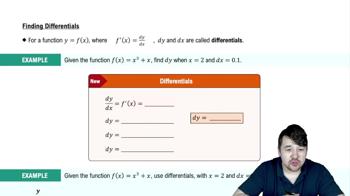
Differential form refers to the expression of derivatives in terms of differentials, typically denoted as dy and dx. In this context, dy represents the change in the function y as x changes, and is calculated using the derivative. This form is particularly useful for understanding how small changes in x affect y.
The quotient rule is a method for finding the derivative of a function that is the ratio of two other functions. If y = u/v, where u and v are functions of x, the derivative is given by dy/dx = (v(du/dx) - u(dv/dx)) / v². This rule is essential for differentiating functions like y = (2√x)/(3(1 + √x)), where both the numerator and denominator are functions of x.