52-56. In this section, several models are presented and the solution of the associated differential equation is given. Later in the chapter, we present methods for solving these differential equations.
(Use of Tech) Chemical rate equations The reaction of certain chemical compounds can be modeled using a differential equation of the form y'(t) = -kyⁿ(t), where y(t) is the concentration of the compound, for t ≥ 0, k > 0 is a constant that determines the speed of the reaction, and n is a positive integer called the order of the reaction. Assume the initial concentration of the compound is y(0) = y₀ > 0.
c. Let y₀ = 1 and k = 0.1. Graph the first-order and second-order solutions found in parts (a) and (b). Compare the two reactions.
Verified step by step guidance
1
Recall the general differential equation for the chemical reaction: \(y'(t) = -k y^{n}(t)\), where \(k > 0\) and \(n\) is the order of the reaction.
For the first-order reaction (\(n=1\)), the differential equation becomes \(y'(t) = -k y(t)\). This is a separable differential equation.
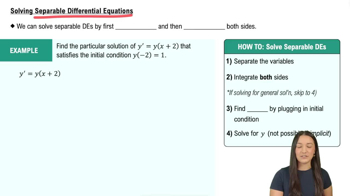
Solve the first-order equation by separating variables: write \(\frac{dy}{dt} = -k y\), then rearrange to \(\frac{dy}{y} = -k dt\). Integrate both sides to find the solution involving an exponential decay.
For the second-order reaction (\(n=2\)), the differential equation is \(y'(t) = -k y^{2}(t)\). Again, separate variables: \(\frac{dy}{dt} = -k y^{2}\) leads to \(\frac{dy}{y^{2}} = -k dt\). Integrate both sides to find the solution, which will be a rational function in \(t\).
With initial condition \(y(0) = y_0 = 1\) and \(k = 0.1\), write explicit expressions for both solutions (first-order and second-order). Then, plot both functions on the same graph for \(t \geq 0\) to compare how the concentration decreases over time for each reaction order.
Verified video answer for a similar problem:
This video solution was recommended by our tutors as helpful for the problem above
Video duration:
3m
Play a video:
0 Comments
Key Concepts
Here are the essential concepts you must grasp in order to answer the question correctly.
Differential Equations in Chemical Kinetics
Chemical rate equations describe how the concentration of a substance changes over time using differential equations. The general form y'(t) = -kyⁿ(t) models the rate of reaction, where y(t) is concentration, k is a positive rate constant, and n is the reaction order. Understanding this setup is essential to analyze how concentration evolves.
The order n in the differential equation indicates how the reaction rate depends on concentration. A first-order reaction (n=1) means the rate is proportional to y(t), leading to exponential decay. A second-order reaction (n=2) depends on the square of concentration, resulting in a different decay pattern. Comparing these helps understand reaction speed and behavior.
Solving the differential equation for given initial conditions y(0) = y₀ and constants k allows us to find explicit formulas for y(t). Graphing these solutions for different orders (n=1 and n=2) visually compares how concentration changes over time, highlighting differences in reaction dynamics and decay rates.