The terms of a sequence of partial sums are defined by Sₙ = ∑ⁿₖ₌₁ k² , for n=1, 2, 3, .....Evaluate the first four terms of the sequence.
Verified step by step guidance
1
Understand that the sequence of partial sums \( S_n = \sum_{k=1}^n k^2 \) represents the sum of the squares of the first \( n \) natural numbers.
Recall the formula for the sum of the first \( n \) squares: \( S_n = \frac{n(n+1)(2n+1)}{6} \). This formula allows you to find \( S_n \) directly without summing each term individually.
Calculate \( S_1 \) by substituting \( n=1 \) into the formula: \( S_1 = \frac{1 \times (1+1) \times (2 \times 1 + 1)}{6} \).
Calculate \( S_2 \) by substituting \( n=2 \) into the formula: \( S_2 = \frac{2 \times (2+1) \times (2 \times 2 + 1)}{6} \).
Similarly, calculate \( S_3 \) and \( S_4 \) by substituting \( n=3 \) and \( n=4 \) respectively into the formula: \( S_3 = \frac{3 \times 4 \times 7}{6} \) and \( S_4 = \frac{4 \times 5 \times 9}{6} \).
Verified video answer for a similar problem:
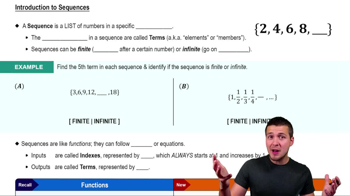
This video solution was recommended by our tutors as helpful for the problem above
Video duration:
4m
Play a video:
0 Comments
Key Concepts
Here are the essential concepts you must grasp in order to answer the question correctly.
Sequence of Partial Sums
A sequence of partial sums is formed by adding the first n terms of a given sequence. Each term Sₙ represents the sum of the first n terms, providing a way to analyze the cumulative behavior of the sequence.
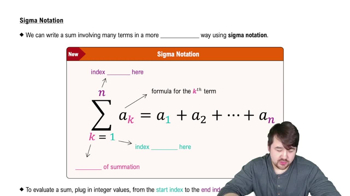
Summation notation (∑) compactly represents the sum of terms. For the sum of squares, the formula ∑ₖ₌₁ⁿ k² = n(n+1)(2n+1)/6 allows direct calculation of the sum without adding each term individually.
To find specific terms of a sequence, substitute the term number n into the formula or expression defining the sequence. This process yields numerical values for the first few terms, facilitating understanding of the sequence's pattern.