In Exercises 53 and 54, find both dy/dx (treating y as a differentiable function of x) and dx/dy (treating x as a differentiable function of y). How do dy/dx and dx/dy seem to be related?
54. x³ + y² = sin²y
Verified step by step guidance
1
Start by differentiating the given equation \(x^3 + y^2 = \sin^2(y)\) with respect to \(x\). Remember to apply implicit differentiation since \(y\) is a function of \(x\).
Differentiate \(x^3\) with respect to \(x\) to get \(3x^2\).
Differentiate \(y^2\) with respect to \(x\) using the chain rule: \(2y \cdot \frac{dy}{dx}\).
Differentiate \(\sin^2(y)\) with respect to \(x\) using the chain rule: \(2\sin(y)\cos(y) \cdot \frac{dy}{dx}\).
Set up the equation from the derivatives: \(3x^2 + 2y \cdot \frac{dy}{dx} = 2\sin(y)\cos(y) \cdot \frac{dy}{dx}\). Solve for \(\frac{dy}{dx}\) and then find \(\frac{dx}{dy}\) by taking the reciprocal of \(\frac{dy}{dx}\).
Verified video answer for a similar problem:
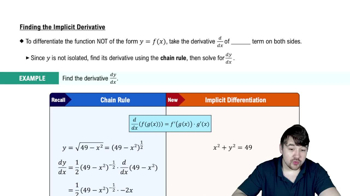
This video solution was recommended by our tutors as helpful for the problem above
Video duration:
6m
Play a video:
0 Comments
Key Concepts
Here are the essential concepts you must grasp in order to answer the question correctly.
Implicit Differentiation
Implicit differentiation is a technique used to find the derivative of a function when it is not explicitly solved for one variable in terms of another. In the equation x³ + y² = sin²y, both x and y are mixed together, requiring implicit differentiation to find dy/dx by differentiating both sides with respect to x, treating y as a function of x.
The inverse function theorem provides a relationship between the derivatives of inverse functions. If dy/dx is the derivative of y with respect to x, then dx/dy is the reciprocal of dy/dx, assuming both derivatives exist and are non-zero. This theorem helps understand how dy/dx and dx/dy are related, as they are inverses of each other.
The chain rule is essential for differentiating composite functions. When finding dy/dx or dx/dy, the chain rule allows us to differentiate expressions involving y as a function of x or x as a function of y. For example, differentiating sin²y with respect to x involves using the chain rule to account for y being a function of x.