51–56. Second derivatives Find d²y/dx². sin x + x²y =10
Verified step by step guidance
1
First, identify the given differential equation: \( \sin x + x^2 y = 10 \). This is a first-order differential equation in terms of \( y \).
To find the second derivative \( \frac{d^2y}{dx^2} \), we first need to differentiate the entire equation with respect to \( x \).
Differentiate both sides of the equation with respect to \( x \): \( \frac{d}{dx}(\sin x) + \frac{d}{dx}(x^2 y) = \frac{d}{dx}(10) \).
Apply the product rule to differentiate \( x^2 y \). The product rule states that \( \frac{d}{dx}(uv) = u'v + uv' \), where \( u = x^2 \) and \( v = y \).
After differentiating, solve for \( \frac{d^2y}{dx^2} \) by differentiating the expression for \( \frac{dy}{dx} \) obtained from the previous step. This will involve applying the chain rule and simplifying the resulting expression.
Verified video answer for a similar problem:
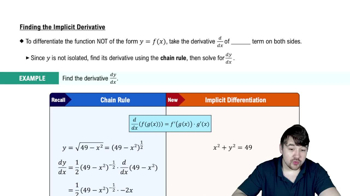
This video solution was recommended by our tutors as helpful for the problem above
Video duration:
9m
Play a video:
0 Comments
Key Concepts
Here are the essential concepts you must grasp in order to answer the question correctly.
Implicit Differentiation
Implicit differentiation is a technique used to differentiate equations where the dependent and independent variables are not explicitly separated. In this case, the equation sin(x) + x²y = 10 involves both x and y, requiring us to differentiate both sides with respect to x while treating y as a function of x. This method allows us to find the first derivative dy/dx before proceeding to the second derivative.
The first derivative, denoted as dy/dx, represents the rate of change of the dependent variable y with respect to the independent variable x. It provides information about the slope of the tangent line to the curve at any point. In the context of the given equation, finding dy/dx is essential for determining how y changes as x varies, which is a prerequisite for calculating the second derivative.
The second derivative, denoted as d²y/dx², measures the rate of change of the first derivative. It provides insights into the curvature of the function and can indicate concavity or points of inflection. In this problem, after finding the first derivative dy/dx, we will differentiate it again to obtain d²y/dx², which will help analyze the behavior of the function y in relation to x.