Right circular cone The lateral surface area S of a right circular cone is related to the base radius r and height h by the equation ______ S = πr √ r² + h².
c. How is dS/dt related to dr/dt and dh/dt if neither r nor h is constant?
Verified step by step guidance
1
To find how dS/dt is related to dr/dt and dh/dt, we need to use implicit differentiation on the given formula for the lateral surface area of the cone: S = πr√(r² + h²).
First, identify the variables: S is the lateral surface area, r is the base radius, and h is the height. Both r and h are functions of time t, so we will differentiate with respect to t.
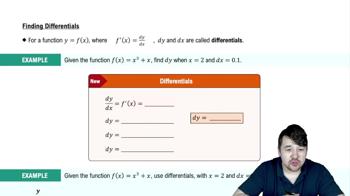
Apply the product rule to differentiate S = πr√(r² + h²) with respect to t. The product rule states that d(uv)/dt = u(dv/dt) + v(du/dt), where u = πr and v = √(r² + h²).
Differentiate u = πr with respect to t to get du/dt = π(dr/dt).
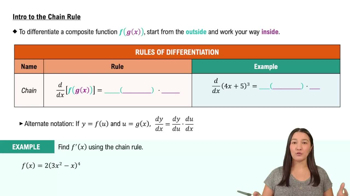
Differentiate v = √(r² + h²) with respect to t using the chain rule. The derivative of √(r² + h²) is (1/2)(r² + h²)^(-1/2) * (2r(dr/dt) + 2h(dh/dt)).
Verified video answer for a similar problem:
This video solution was recommended by our tutors as helpful for the problem above
Video duration:
4m
Play a video:
0 Comments
Key Concepts
Here are the essential concepts you must grasp in order to answer the question correctly.
Related Rates
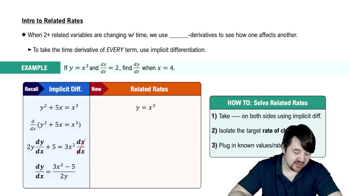
Related rates are a concept in calculus that deals with the relationship between different rates of change. When two or more variables are related by an equation, the rate of change of one variable can be expressed in terms of the rate of change of another. In this context, we are interested in how the lateral surface area of a cone changes with respect to time as both the radius and height change.
Differentiation is a fundamental concept in calculus that involves finding the derivative of a function. The derivative represents the rate of change of a function with respect to its variable. In the context of the given problem, we will differentiate the surface area equation with respect to time to find the relationship between the rates of change of the radius, height, and surface area.
The chain rule is a formula used in calculus to compute the derivative of a composite function. It states that if a variable depends on another variable, which in turn depends on a third variable, the derivative of the outer function is multiplied by the derivative of the inner function. In this problem, we will apply the chain rule to relate the rates of change of the surface area, radius, and height of the cone.