First, understand the given limit expression: lim(x→4) (f(x) − 5) / (x − 2) = 1. This indicates that as x approaches 4, the expression (f(x) − 5) / (x − 2) approaches 1.
Recognize that this is a limit problem involving a rational expression. The numerator is (f(x) − 5) and the denominator is (x − 2). The limit is given as x approaches 4.
To find lim(x→4) f(x), consider the behavior of the function f(x) as x approaches 4. The expression (f(x) − 5) / (x − 2) approaching 1 suggests that f(x) can be expressed in a form that allows simplification.
Assume f(x) can be expressed as f(x) = a(x − 2) + 5, where a is a constant. This form allows the expression (f(x) − 5) / (x − 2) to simplify to a, which should equal 1 based on the given limit.
Substitute x = 4 into the expression f(x) = a(x − 2) + 5 to find lim(x→4) f(x). Since a = 1, the expression becomes f(4) = 1(4 − 2) + 5, which simplifies to the value of the limit.
Verified video answer for a similar problem:
This video solution was recommended by our tutors as helpful for the problem above
Video duration:
2m
Play a video:
0 Comments
Key Concepts
Here are the essential concepts you must grasp in order to answer the question correctly.
Limits
A limit is a fundamental concept in calculus that describes the behavior of a function as its input approaches a certain value. In this case, we are interested in the limit of the function f(x) as x approaches 4. Understanding limits is crucial for evaluating functions at points where they may not be explicitly defined.
L'Hôpital's Rule is a method used to evaluate limits of indeterminate forms, such as 0/0 or ∞/∞. It states that if the limit of f(x)/g(x) results in an indeterminate form, the limit can be found by taking the derivative of the numerator and the derivative of the denominator. This rule can simplify the process of finding limits in complex scenarios.
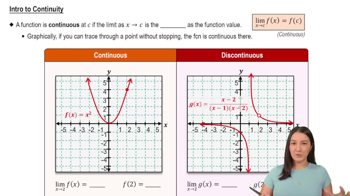
A function is continuous at a point if the limit of the function as it approaches that point equals the function's value at that point. In this problem, understanding the continuity of f(x) at x = 4 is essential, as it allows us to directly relate the limit of (f(x) - 5)/(x - 2) to the limit of f(x) itself.

 2:41 minutes
 Verified step by step guidance

 05:50
05:50