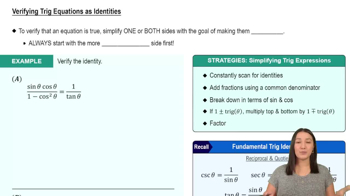
Start by recalling the definition of the tangent function in terms of sine and cosine: \( \tan\theta = \frac{\sin\theta}{\cos\theta} \). This is a fundamental trigonometric identity.
To prove the identity \( \tan\theta = \frac{\sin\theta}{\cos\theta} \), we need to express \( \tan\theta \) in terms of \( \sin\theta \) and \( \cos\theta \).
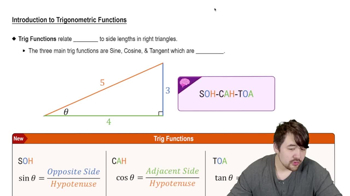
The tangent of an angle \( \theta \) in a right triangle is defined as the ratio of the opposite side to the adjacent side. In terms of the unit circle, this translates to \( \tan\theta = \frac{y}{x} \), where \( y = \sin\theta \) and \( x = \cos\theta \).
Thus, substituting the unit circle definitions, we have \( \tan\theta = \frac{\sin\theta}{\cos\theta} \), which matches the given identity.
Therefore, the identity \( \tan\theta = \frac{\sin\theta}{\cos\theta} \) is proven using the definitions of sine, cosine, and tangent in the context of the unit circle.
Verified video answer for a similar problem:
This video solution was recommended by our tutors as helpful for the problem above
Video duration:
2m
Play a video:
0 Comments
Key Concepts
Here are the essential concepts you must grasp in order to answer the question correctly.
Trigonometric Functions
Trigonometric functions, such as sine, cosine, and tangent, relate the angles of a triangle to the ratios of its sides. The tangent function, specifically, is defined as the ratio of the length of the opposite side to the length of the adjacent side in a right triangle. Understanding these functions is crucial for proving identities and solving problems in trigonometry.
Trigonometric identities are equations that involve trigonometric functions and are true for all values of the variables involved. The identity an heta = rac{ ext{sin} heta}{ ext{cos} heta} is a fundamental identity that expresses tangent in terms of sine and cosine. Familiarity with these identities is essential for simplifying expressions and proving relationships between different trigonometric functions.
Proof techniques in mathematics involve logical reasoning to demonstrate the truth of a statement or identity. Common methods include direct proof, proof by contradiction, and using known identities to derive new results. In the context of trigonometric identities, one often uses algebraic manipulation and substitution to establish the validity of the identity being proved.