Functions from arc length What differentiable functions have an arc length on the interval [a, b] given by the following integrals? Note that the answers are not unique. Give a family of functions that satisfy the conditions. a. ∫a^b √1+16x⁴ dx
Verified step by step guidance
1
Recall that the arc length of a function \(y = f(x)\) on the interval \([a, b]\) is given by the integral \(\int_a^b \sqrt{1 + (f'(x))^2} \, dx\).
Compare the given integral \(\int_a^b \sqrt{1 + 16x^4} \, dx\) with the arc length formula. This means that \(\sqrt{1 + (f'(x))^2} = \sqrt{1 + 16x^4}\).
From the equality inside the square roots, deduce that \((f'(x))^2 = 16x^4\).
Take the square root of both sides to find \(f'(x) = \pm 4x^2\).
Integrate \(f'(x)\) to find the family of functions: \(f(x) = \pm \int 4x^2 \, dx = \pm \frac{4}{3} x^3 + C\), where \(C\) is an arbitrary constant.
Verified video answer for a similar problem:
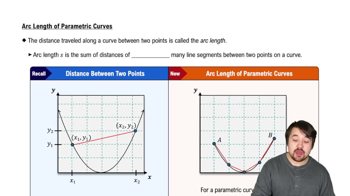
This video solution was recommended by our tutors as helpful for the problem above
Video duration:
2m
Play a video:
0 Comments
Key Concepts
Here are the essential concepts you must grasp in order to answer the question correctly.
Arc Length Formula
The arc length of a differentiable function y = f(x) over [a, b] is given by the integral ∫_a^b √(1 + (f'(x))²) dx. This formula measures the length of the curve by summing infinitesimal line segments, incorporating the slope of the function through its derivative.
Relationship Between the Integrand and the Derivative
In the arc length integral, the integrand √(1 + (f'(x))²) reveals how the derivative f'(x) relates to the given expression under the square root. To find functions with a specified arc length integral, one must equate (f'(x))² to the expression inside the integral minus 1 and solve for f'(x).
Once f'(x) is determined, integrating it yields a family of functions differing by a constant of integration. This reflects the non-uniqueness of solutions, as any vertical shift of the function preserves the same derivative and thus the same arc length integral.