The energy (in joules) released by an earthquake of magnitude M is given by the equation E=25,000 ⋅ 101.5M. (This equation can be solved for M to define the magnitude of a given earthquake; it is a refinement of the original Richter scale created by Charles Richter in 1935.) Compute dE/dM and evaluate it for M=3. What does this derivative mean? (M has no units, so the units of the derivative are J per change in magnitude.)
Verified step by step guidance
1
First, identify the function given in the problem: \( E = 25,000 \cdot 10^{1.5M} \). This represents the energy released by an earthquake as a function of its magnitude \( M \).
To find \( \frac{dE}{dM} \), we need to differentiate the function \( E \) with respect to \( M \). Notice that the function involves an exponential term \( 10^{1.5M} \).
Apply the chain rule for differentiation. The derivative of \( 10^{1.5M} \) with respect to \( M \) is \( 10^{1.5M} \cdot \ln(10) \cdot 1.5 \). Multiply this by the constant 25,000 to get the derivative: \( \frac{dE}{dM} = 25,000 \cdot 10^{1.5M} \cdot \ln(10) \cdot 1.5 \).
Now, substitute \( M = 3 \) into the derivative \( \frac{dE}{dM} \) to evaluate it at this specific magnitude. This involves calculating \( 25,000 \cdot 10^{4.5} \cdot \ln(10) \cdot 1.5 \).
The derivative \( \frac{dE}{dM} \) represents the rate of change of energy with respect to the magnitude of the earthquake. It tells us how much the energy released by the earthquake increases for a small increase in magnitude \( M \). The units of this derivative are joules per change in magnitude.
Verified video answer for a similar problem:
This video solution was recommended by our tutors as helpful for the problem above
Video duration:
5m
Play a video:
0 Comments
Key Concepts
Here are the essential concepts you must grasp in order to answer the question correctly.
Derivative
A derivative represents the rate of change of a function with respect to a variable. In this context, dE/dM indicates how the energy E released by an earthquake changes as the magnitude M changes. It quantifies the sensitivity of energy release to variations in magnitude, providing insight into the relationship between these two variables.
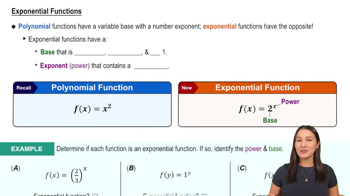
The equation E=25,000 ⋅ 10<sup>1.5M</sup> is an example of an exponential function, where the variable M is in the exponent. Exponential functions grow rapidly, and in this case, they illustrate how small increases in magnitude can lead to significant increases in energy release. Understanding the properties of exponential functions is crucial for analyzing the behavior of E as M changes.
The magnitude scale, originally developed by Charles Richter, quantifies the size of earthquakes. It is a logarithmic scale, meaning each whole number increase on the scale corresponds to a tenfold increase in measured amplitude and approximately 31.6 times more energy release. This concept is essential for interpreting the results of the derivative, as it contextualizes how energy release varies with changes in magnitude.

 5:01 minutes
 Verified step by step guidance

 05:44
05:44