Power series from the geometric series Use the geometric series a Σₖ ₌ ₀ ∞ (x)ᵏ = 1/(1 - x), for |x| < 1, to determine the Maclaurin series and the interval of convergence for the following functions.
ƒ(x) = 1/(1 + 5x)
Verified step by step guidance
1
Recall the geometric series formula: \(\sum_{k=0}^{\infty} x^k = \frac{1}{1 - x}\) for \(|x| < 1\).
Rewrite the given function \(f(x) = \frac{1}{1 + 5x}\) in a form similar to the geometric series by expressing the denominator as \$1 - (-5x)$.
Identify the term inside the geometric series as \(-5x\), so the series becomes \(\sum_{k=0}^{\infty} (-5x)^k\).
Write the Maclaurin series explicitly as \(\sum_{k=0}^{\infty} (-1)^k 5^k x^k\).
Determine the interval of convergence by applying the condition \(| -5x | < 1\), which simplifies to \(|x| < \frac{1}{5}\).
Verified video answer for a similar problem:
This video solution was recommended by our tutors as helpful for the problem above
Video duration:
4m
Play a video:
Was this helpful?
Key Concepts
Here are the essential concepts you must grasp in order to answer the question correctly.
Geometric Series and Its Sum Formula
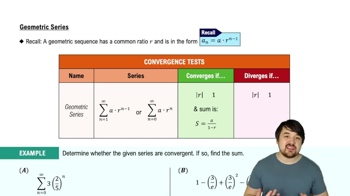
A geometric series is an infinite sum of the form Σ x^k, where each term is a constant ratio times the previous term. Its sum converges to 1/(1 - x) for |x| < 1. This formula is fundamental for expressing functions as power series by rewriting them in a geometric series form.
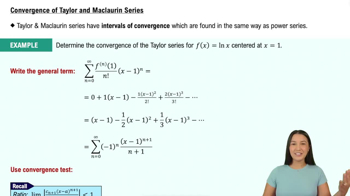
The Maclaurin series is a Taylor series expansion of a function about x = 0. It represents the function as an infinite sum of powers of x with coefficients derived from the function's derivatives at zero. This series helps approximate functions near zero and is used to find power series representations.
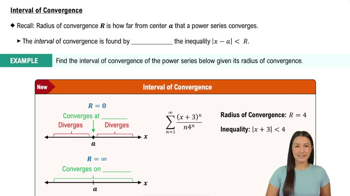
The interval of convergence is the set of x-values for which a power series converges to the function. For geometric series, it is determined by the condition |x| < 1 after rewriting the function in the form 1/(1 - r). Identifying this interval ensures the power series accurately represents the function within that range.