Find the limits in Exercises 53–58. Write ∞ or −∞ where appropriate.
lim (x² − 3x + 2) / (x³ − 2x²) as
a. x→0⁺
Verified step by step guidance
1
Step 1: Begin by substituting x = 0 into the function \((x^2 - 3x + 2) / (x^3 - 2x^2)\) to check if the limit can be directly evaluated. This will help identify if the function is undefined at x = 0.
Step 2: Since direct substitution results in an indeterminate form \(0/0\), apply L'Hôpital's Rule, which is used to evaluate limits of indeterminate forms. Differentiate the numerator \(x^2 - 3x + 2\) and the denominator \(x^3 - 2x^2\) separately.
Step 4: Substitute x = 0 into the differentiated function \((2x - 3) / (3x^2 - 4x)\) to evaluate the limit as x approaches 0 from the positive side.
Step 5: Analyze the behavior of the function as x approaches 0 from the positive side. Consider the signs of the numerator and denominator to determine if the limit approaches \(\infty\), \(-\infty\), or a finite value.
Verified video answer for a similar problem:
This video solution was recommended by our tutors as helpful for the problem above
Video duration:
2m
Play a video:
0 Comments
Key Concepts
Here are the essential concepts you must grasp in order to answer the question correctly.
Limits
Limits are fundamental concepts in calculus that describe the behavior of a function as its input approaches a certain value. They help in understanding the function's behavior near points of interest, including points where the function may not be explicitly defined. Evaluating limits is crucial for determining continuity, derivatives, and integrals.
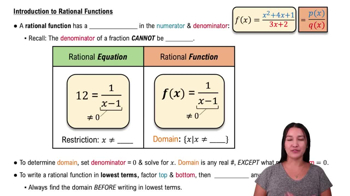
Rational functions are expressions formed by the ratio of two polynomials. In the given limit problem, the function consists of a polynomial in the numerator and another in the denominator. Understanding how to simplify and analyze rational functions is essential for finding limits, especially when dealing with indeterminate forms.
One-sided limits refer to the value that a function approaches as the input approaches a specific point from one side, either the left (x→c⁻) or the right (x→c⁺). In this problem, evaluating the limit as x approaches 0 from the positive side (0⁺) is important for understanding the function's behavior near that point, particularly when the function may behave differently from each side.

 2:58 minutes
 Verified step by step guidance

 05:50
05:50