38–43. Equilibrium solutions A differential equation of the form y′(t)=f(y) is said to be autonomous (the function f depends only on y). The constant function y=y0 is an equilibrium solution of the equation provided f(y0)=0 (because then y'(t)=0 and the solution remains constant for all t). Note that equilibrium solutions correspond to horizontal lines in the direction field. Note also that for autonomous equations, the direction field is independent of t. Carry out the following analysis on the given equations. b. Sketch the direction field, for t≥0.
y′(t) = 2y + 4
Verified step by step guidance
1
Identify the given autonomous differential equation: \(y'(t) = 2y + 4\). Since it depends only on \(y\), it fits the form \(y'(t) = f(y)\) with \(f(y) = 2y + 4\).
Find the equilibrium solution(s) by setting \(f(y) = 0\), which means solving \$2y + 4 = 0\( for \)y$. This gives the constant solution(s) where the slope is zero.
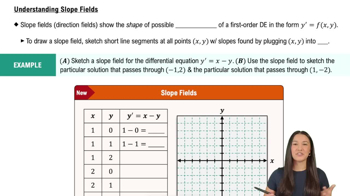
Understand that the direction field consists of small line segments at various points \((t, y)\) with slope given by \(y'(t) = 2y + 4\). Since the equation is autonomous, the slope depends only on \(y\), not on \(t\).
To sketch the direction field for \(t \geq 0\), choose several values of \(y\) (both above and below the equilibrium solution) and calculate the slope \$2y + 4\( at each. Draw short line segments with these slopes at points along the vertical lines for different \)t$ values.
Note that at the equilibrium solution, the slope is zero, so the direction field will have horizontal line segments. For \(y\) values greater than the equilibrium, the slope will be positive (lines slanting upward), and for \(y\) values less than the equilibrium, the slope will be negative (lines slanting downward). This helps visualize the behavior of solutions over time.
Verified video answer for a similar problem:
This video solution was recommended by our tutors as helpful for the problem above
Video duration:
4m
Play a video:
0 Comments
Key Concepts
Here are the essential concepts you must grasp in order to answer the question correctly.
Autonomous Differential Equations
An autonomous differential equation has the form y' = f(y), where the rate of change depends only on y, not explicitly on t. This means the behavior of solutions depends solely on the current value of y, making the direction field invariant along the t-axis. Understanding this helps in analyzing solution curves and equilibrium points.
Equilibrium solutions occur where y' = f(y) = 0, meaning the solution y(t) remains constant over time. These correspond to horizontal lines in the direction field and represent steady states of the system. Identifying equilibrium points is crucial for sketching direction fields and understanding long-term behavior.
A direction field is a graphical tool that shows the slope y' = f(t,y) at various points in the plane. For autonomous equations, slopes depend only on y, so the field is uniform in t. Sketching direction fields helps visualize solution trajectories and stability of equilibria without solving the equation explicitly.

 4:10 minutes
 Verified step by step guidance
 07:39
07:39