Sketch a graph of a function f with the following properties.
f' < 0 and f" < 0, for x < 3
Verified step by step guidance
1
Understand the given conditions: f'(x) < 0 implies the function f is decreasing, and f''(x) < 0 implies the function is concave down for x < 3.
Start by sketching the graph for x < 3. Since f'(x) < 0, the graph should slope downward as x approaches 3. This indicates a decreasing function.
Next, incorporate the concavity condition f''(x) < 0. Concave down means the graph curves downward, resembling a 'frown' shape. Ensure the graph bends downward as it decreases.
Choose a point at x = 3 to mark the boundary where the given conditions apply. The behavior of the graph beyond x = 3 is not specified, so focus only on the region x < 3.
Label the axes and ensure the graph visually represents both decreasing behavior and concave down curvature for x < 3. This completes the sketch based on the given properties.
Verified video answer for a similar problem:
This video solution was recommended by our tutors as helpful for the problem above
Video duration:
3m
Play a video:
0 Comments
Key Concepts
Here are the essential concepts you must grasp in order to answer the question correctly.
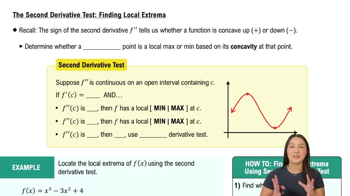
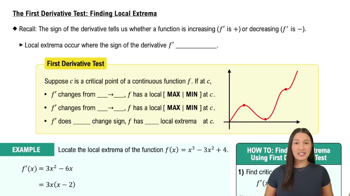
First Derivative Test
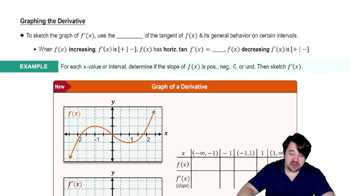
The first derivative of a function, denoted as f', indicates the slope of the tangent line to the graph at any point. If f' < 0, the function is decreasing in that interval. Understanding this concept is crucial for sketching the graph, as it informs us that the function is moving downward for x < 3.
The second derivative, denoted as f'', provides information about the concavity of the function. If f'' < 0, the function is concave down, meaning that the slope of the tangent line is decreasing. This concept is essential for determining the curvature of the graph, indicating that the function is bending downwards for x < 3.
Understanding how the first and second derivatives affect the graph's behavior is key to sketching it accurately. With f' < 0 and f'' < 0 for x < 3, the graph will not only be decreasing but also concave down, suggesting a continuous downward slope that becomes steeper as x approaches 3. This overall behavior shapes the visual representation of the function.

 3:45 minutes
 Verified step by step guidance
 07:09
07:09