53–57. Conic sections a. Determine whether the following equations describe a parabola, an ellipse, or a hyperbola. x = 16y²
Verified step by step guidance
1
Recall the general forms of conic sections:
- Parabola: one variable is squared, the other is to the first power (e.g., \(y^2 = 4ax\) or \(x^2 = 4ay\)).
- Ellipse: both variables are squared with the same sign and different coefficients (e.g., \(\frac{x^2}{a^2} + \frac{y^2}{b^2} = 1\)).
- Hyperbola: both variables are squared but with opposite signs (e.g., \(\frac{x^2}{a^2} - \frac{y^2}{b^2} = 1\) or \(-\frac{x^2}{a^2} + \frac{y^2}{b^2} = 1\)).
Look at the given equation: \(x = 16y^2\). Notice that \(x\) is to the first power and \(y\) is squared.
Rewrite the equation to isolate zero on one side: \(x - 16y^2 = 0\). This shows only one variable is squared and the other is linear.
Since only one variable is squared and the other is linear, this matches the form of a parabola, where the squared term is on one side and the linear term on the other.
Therefore, conclude that the equation \(x = 16y^2\) represents a parabola.
Verified video answer for a similar problem:
This video solution was recommended by our tutors as helpful for the problem above
Video duration:
2m
Play a video:
0 Comments
Key Concepts
Here are the essential concepts you must grasp in order to answer the question correctly.
Conic Sections and Their Standard Forms
Conic sections are curves obtained by intersecting a plane with a double-napped cone, resulting in parabolas, ellipses, or hyperbolas. Each conic has a standard equation form, such as y² = 4ax for parabolas, (x²/a²) + (y²/b²) = 1 for ellipses, and (x²/a²) - (y²/b²) = 1 for hyperbolas. Recognizing these forms helps classify the given equation.
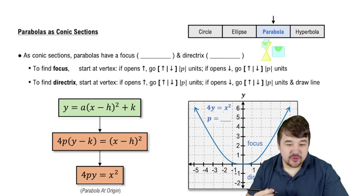
A parabola is characterized by an equation where one variable is squared and the other is to the first power, typically in the form x = ay² or y = ax². The given equation x = 16y² fits this pattern, indicating it is a parabola opening along the x-axis. Understanding this helps distinguish it from ellipses and hyperbolas.
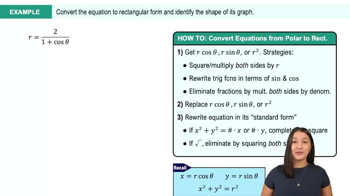
Convert Equations from Polar to Rectangular Example 2
Graphical Interpretation of Conic Sections
Graphing the equation provides visual insight into the conic's shape and orientation. For x = 16y², the parabola opens rightward since x depends on y² with a positive coefficient. Recognizing the direction and shape of the graph aids in confirming the type of conic section represented by the equation.

 2:12 minutes
 Verified step by step guidance
 5:33
5:33