Indefinite integrals Use a change of variables or Table 5.6 to evaluate the following indefinite integrals. Check your work by differentiating. β« [ 1/(10πβ3) dπ
Verified step by step guidance
1
Step 1: Recognize that the integral β« [1/(10π - 3)] dπ can be solved using a substitution method. Let u = 10π - 3, which simplifies the denominator.
Step 2: Compute the derivative of u with respect to π. Since u = 10π - 3, du/dπ = 10. Rearrange to express dπ in terms of du: dπ = du/10.
Step 3: Substitute u and dπ into the integral. The integral becomes β« [1/u] * (du/10), which simplifies to (1/10) β« [1/u] du.
Step 4: Recall the standard integral formula β« [1/u] du = ln|u| + C, where C is the constant of integration. Apply this formula to the integral.
Step 5: Replace u with the original variable to return to the terms of π. Since u = 10π - 3, the solution becomes (1/10) ln|10π - 3| + C.
Verified video answer for a similar problem:
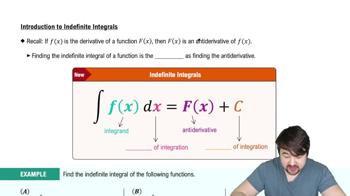
This video solution was recommended by our tutors as helpful for the problem above
Video duration:
1m
Play a video:
0 Comments
Key Concepts
Here are the essential concepts you must grasp in order to answer the question correctly.
Indefinite Integrals
Indefinite integrals represent a family of functions whose derivative is the integrand. They are expressed without limits and include a constant of integration, typically denoted as 'C'. The process of finding an indefinite integral is often referred to as antidifferentiation, and it is fundamental in calculus for solving problems related to area under curves and accumulation functions.
Change of variables, or substitution, is a technique used in integration to simplify the integrand. By substituting a new variable for a function of the original variable, the integral can often be transformed into a more manageable form. This method is particularly useful when dealing with complex functions or when the integrand can be expressed in a simpler way through a different variable.
Checking work by differentiation involves taking the derivative of the result obtained from an indefinite integral to verify its correctness. If the derivative of the antiderivative matches the original integrand, the solution is confirmed to be correct. This step is crucial in calculus as it ensures that the integration process has been performed accurately and helps identify any potential errors in the calculations.