39–40. {Use of Tech} Lower and upper bounds of a series For each convergent series and given value of n, use Theorem 10.13 to complete the following.
c. Find lower and upper bounds (Lₙ and Uₙ, respectively) for the exact value of the series.
39. ∑ (k = 1 to ∞) 1 / k⁷ ; n = 2
Verified step by step guidance
1
Identify the series given: \( \sum_{k=1}^{\infty} \frac{1}{k^7} \). This is a p-series with \( p = 7 > 1 \), so it converges.
Recall Theorem 10.13, which states that for a convergent series with positive, decreasing terms, the remainder \( R_n = S - S_n \) (the error when approximating the sum by the first \( n \) terms) is bounded by the integral test inequalities:
This video solution was recommended by our tutors as helpful for the problem above
Video duration:
5m
Play a video:
0 Comments
Key Concepts
Here are the essential concepts you must grasp in order to answer the question correctly.
Convergent Series
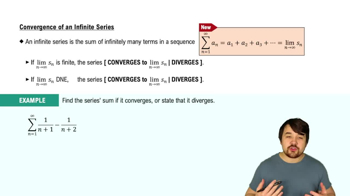
A convergent series is an infinite sum whose partial sums approach a finite limit. Understanding convergence ensures that the series has a well-defined sum, which is essential when estimating bounds for the series' exact value.
Theorem 10.13 provides a method to find lower and upper bounds for the sum of a convergent series using partial sums and remainder estimates. It typically involves comparing the remainder to an integral or another expression to bound the error after n terms.
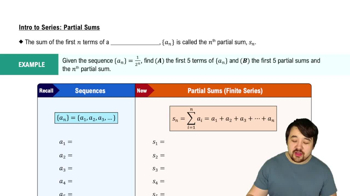
Partial sums sum the first n terms of a series, approximating the total sum. The remainder is the difference between the exact sum and the partial sum. Estimating this remainder allows us to find bounds (Lₙ and Uₙ) that enclose the true sum.