Use the graph of f in the figure to find the following values or state that they do not exist. If a limit does not exist, explain why. <IMAGE>
l.
Verified step by step guidance
1
Examine the graph of the function \( f(x) \) around \( x = 2 \).
Check the behavior of \( f(x) \) as \( x \) approaches 2 from the left (\( x \to 2^- \)).
Check the behavior of \( f(x) \) as \( x \) approaches 2 from the right (\( x \to 2^+ \)).
Compare the left-hand limit and the right-hand limit to determine if they are equal.
If both one-sided limits are equal, the limit \( \lim_{x\to2}f(x) \) exists and is equal to that common value; otherwise, state that the limit does not exist.
Verified video answer for a similar problem:

This video solution was recommended by our tutors as helpful for the problem above
Video duration:
3m
Play a video:
0 Comments
Key Concepts
Here are the essential concepts you must grasp in order to answer the question correctly.
Limits
A limit describes the behavior of a function as the input approaches a certain value. It is essential for understanding continuity and the behavior of functions near points of interest. For example, the limit of f(x) as x approaches 2 indicates what value f(x) is approaching as x gets closer to 2, which can be crucial for determining the function's behavior at that point.
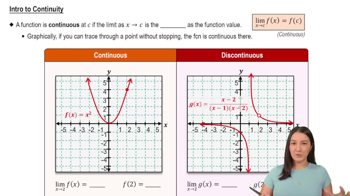
A function is continuous at a point if the limit as x approaches that point equals the function's value at that point. This concept is vital for determining whether a limit exists. If there is a jump, hole, or asymptote at the point in question, the function may not be continuous, leading to a limit that does not exist.
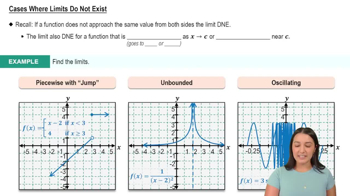
The existence of a limit requires that the left-hand limit and right-hand limit at a point are equal. If these two limits differ or if one of them does not exist, then the overall limit does not exist. Understanding this concept is crucial for analyzing the graph of f and determining the limit as x approaches 2.