Use an appropriate limit definition to prove the following limits.
lim x→1 (5x−2) =3;
Verified step by step guidance
1
Start by recalling the definition of a limit: \( \lim_{{x \to a}} f(x) = L \) means that for every \( \epsilon > 0 \), there exists a \( \delta > 0 \) such that if \( 0 < |x - a| < \delta \), then \( |f(x) - L| < \epsilon \).
Identify the function \( f(x) = 5x - 2 \), the point \( a = 1 \), and the limit \( L = 3 \).
Set up the inequality \( |f(x) - L| < \epsilon \) which becomes \( |(5x - 2) - 3| < \epsilon \). Simplify this to \( |5x - 5| < \epsilon \).
Factor the expression inside the absolute value: \( |5(x - 1)| < \epsilon \). This simplifies to \( 5|x - 1| < \epsilon \).
Solve for \( |x - 1| \) by dividing both sides by 5: \( |x - 1| < \frac{\epsilon}{5} \). Choose \( \delta = \frac{\epsilon}{5} \) to satisfy the limit definition.
Verified video answer for a similar problem:
This video solution was recommended by our tutors as helpful for the problem above
Video duration:
4m
Play a video:
0 Comments
Key Concepts
Here are the essential concepts you must grasp in order to answer the question correctly.
Limit Definition
The limit definition in calculus refers to the formal approach to determining the value that a function approaches as the input approaches a certain point. Specifically, for a function f(x), the limit as x approaches a value 'a' is L if, for every ε > 0, there exists a δ > 0 such that whenever 0 < |x - a| < δ, it follows that |f(x) - L| < ε. This definition is foundational for proving limits rigorously.
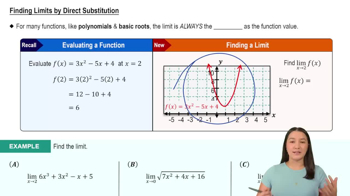
Direct substitution is a method used to evaluate limits by substituting the value that x approaches directly into the function. If the function is continuous at that point, the limit can be found simply by replacing x with the target value. In the case of the limit lim x→1 (5x−2), substituting x = 1 yields the result 3, confirming the limit without further manipulation.
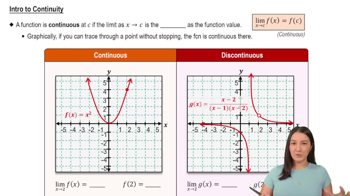
A function is continuous at a point if the limit of the function as it approaches that point equals the function's value at that point. For the limit lim x→1 (5x−2), the function is a polynomial, which is continuous everywhere. This property allows us to confidently use direct substitution to evaluate the limit, reinforcing the relationship between limits and continuity in calculus.

 4:09 minutes
 Verified step by step guidance

 05:50
05:50