23–68. Indefinite integrals Determine the following indefinite integrals. Check your work by differentiation.
∫ (3x ¹⸍³ + 4x ⁻¹⸍³ + 6) dx
Verified step by step guidance
1
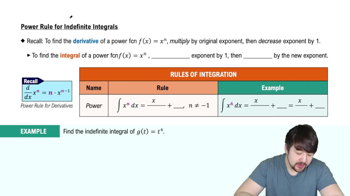
Step 1: Recall the power rule for integration, which states that for any term of the form ∫xⁿ dx, the integral is (xⁿ⁺¹)/(n+1) + C, where n ≠ -1. Apply this rule to each term in the integrand.
Step 2: For the first term, 3x¹⸍³, increase the exponent by 1 (1/3 + 1 = 4/3) and divide by the new exponent. The integral becomes (3x⁴⸍³)/(4/3). Simplify this expression.
Step 3: For the second term, 4x⁻¹⸍³, increase the exponent by 1 (-1/3 + 1 = 2/3) and divide by the new exponent. The integral becomes (4x²⸍³)/(2/3). Simplify this expression.
Step 4: For the constant term, 6, recall that the integral of a constant is the constant multiplied by x. Thus, the integral of 6 is 6x.
Step 5: Combine all the results from the previous steps and add the constant of integration, C, to form the final indefinite integral. Check your work by differentiating the result to ensure it matches the original integrand.
Verified video answer for a similar problem:
This video solution was recommended by our tutors as helpful for the problem above
Video duration:
3m
Play a video:
0 Comments
Key Concepts
Here are the essential concepts you must grasp in order to answer the question correctly.
Indefinite Integrals
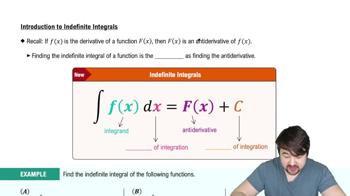
Indefinite integrals represent a family of functions whose derivative is the integrand. They are expressed without limits and include a constant of integration, typically denoted as 'C'. The process of finding an indefinite integral is often referred to as antiderivation, where we seek a function F(x) such that F'(x) equals the integrand.
The power rule for integration is a fundamental technique used to integrate polynomial functions. It states that for any real number n ≠ -1, the integral of x^n with respect to x is (x^(n+1))/(n+1) + C. This rule simplifies the process of integrating terms like 3x^(1/3) and 4x^(-1/3) in the given integral.
To verify the correctness of an indefinite integral, one can differentiate the result obtained from the integration. If the derivative of the antiderivative matches the original integrand, the integration is confirmed to be correct. This process reinforces the relationship between differentiation and integration, as they are inverse operations.