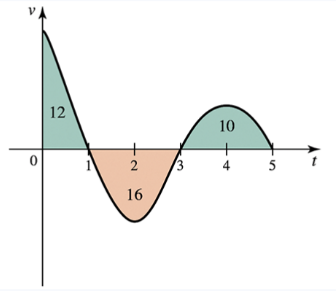
Displacement and distance from velocity Consider the graph shown in the figure, which gives the velocity of an object moving along a line. Assume time is measured in hours and distance is measured in miles. The areas of three regions bounded by the velocity curve and the t-axis are also given. b. What is the displacement of the object over the interval [0,3]?
Verified step by step guidance
1
Understand that displacement over a time interval is given by the definite integral of the velocity function over that interval. In this case, displacement from time \(t=0\) to \(t=3\) is the integral of velocity \(v(t)\) from 0 to 3.
Identify the areas under the velocity curve between \(t=0\) and \(t=3\) from the graph. The graph shows two regions: one above the \(t\)-axis from \(t=0\) to \(t=1\) with area 12, and one below the \(t\)-axis from \(t=1\) to \(t=3\) with area 16.
Recall that areas above the \(t\)-axis correspond to positive velocity (positive contribution to displacement), and areas below the \(t\)-axis correspond to negative velocity (negative contribution to displacement).
Calculate the net displacement by subtracting the area below the \(t\)-axis from the area above the \(t\)-axis over the interval \([0,3]\). This means displacement = (area above) - (area below) = 12 - 16.
Express the displacement as the net signed area under the velocity curve from \(t=0\) to \(t=3\), which represents the total change in position of the object during this time.
Verified video answer for a similar problem:
This video solution was recommended by our tutors as helpful for the problem above
Video duration:
2m
Play a video:
0 Comments
Key Concepts
Here are the essential concepts you must grasp in order to answer the question correctly.
Velocity and Displacement
Velocity represents the rate of change of position with respect to time. Displacement over a time interval is the net change in position, calculated as the integral of velocity over that interval. Positive velocity contributes to forward displacement, while negative velocity contributes to backward displacement.
The definite integral of a velocity function over a time interval corresponds to the net area between the velocity curve and the time axis. Areas above the axis are positive, and areas below are negative, reflecting direction. This integral gives the displacement, not the total distance traveled.
Displacement is the net change in position and can be positive, negative, or zero, depending on direction. Distance is the total length traveled, always positive, and equals the sum of the absolute values of areas under the velocity curve. Understanding this distinction is crucial for interpreting velocity graphs.