Write the equations that are used to express a point with polar coordinates (r, θ) in Cartesian coordinates.
Verified step by step guidance
1
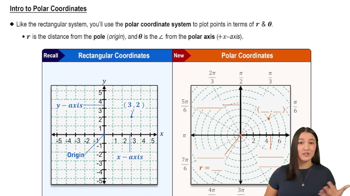
Recall that polar coordinates \((r, \theta)\) represent a point in the plane by its distance \(r\) from the origin and the angle \(\theta\) it makes with the positive x-axis.
To convert from polar to Cartesian coordinates \((x, y)\), we use the relationships based on trigonometry in the right triangle formed by the point, the origin, and the projection on the x-axis.
The x-coordinate is found by projecting the point onto the x-axis, which is given by \(x = r \cos(\theta)\).
Similarly, the y-coordinate is found by projecting the point onto the y-axis, which is given by \(y = r \sin(\theta)\).
Thus, the equations to convert from polar to Cartesian coordinates are:
\[ x = r \cos(\theta) \]
\[ y = r \sin(\theta) \]
Verified video answer for a similar problem:
This video solution was recommended by our tutors as helpful for the problem above
Video duration:
1m
Play a video:
0 Comments
Key Concepts
Here are the essential concepts you must grasp in order to answer the question correctly.
Polar Coordinates
Polar coordinates represent a point in the plane using a distance from the origin (r) and an angle (θ) measured from the positive x-axis. This system is useful for describing locations in circular or rotational contexts.
Cartesian coordinates specify a point by its horizontal (x) and vertical (y) distances from the origin along perpendicular axes. This rectangular coordinate system is the standard for graphing and analyzing points in the plane.
Conversion Formulas between Polar and Cartesian Coordinates
To convert from polar to Cartesian coordinates, use the formulas x = r cos(θ) and y = r sin(θ). These equations translate the distance and angle into horizontal and vertical components, enabling the representation of the same point in Cartesian form.

 1:50 minutes
 Verified step by step guidance
 05:32
05:32