For what value or values of the constant m, if any, is
ƒ(x) = { sin 2x, x ≤ 0 { mx, x > 0
a. continuous at x = 0? b. differentiable at x = 0?
Give reasons for your answers.
Verified step by step guidance
1
To determine if the function is continuous at x = 0, we need to check if the left-hand limit, right-hand limit, and the function value at x = 0 are equal. The left-hand limit as x approaches 0 from the left is lim(x→0-) sin(2x). Since sin(2x) is continuous, this limit is sin(0) = 0.
The right-hand limit as x approaches 0 from the right is lim(x→0+) mx. This limit is m*0 = 0. For the function to be continuous at x = 0, the left-hand limit, right-hand limit, and f(0) must all be equal. Since f(0) = sin(0) = 0, the function is continuous at x = 0 for any value of m.
To determine if the function is differentiable at x = 0, we need to check if the derivative from the left and the derivative from the right at x = 0 are equal. The derivative of sin(2x) with respect to x is 2cos(2x). Evaluating this at x = 0 gives 2cos(0) = 2.
The derivative of mx with respect to x is m. For the function to be differentiable at x = 0, the left-hand derivative (2) must equal the right-hand derivative (m). Therefore, m must be equal to 2 for the function to be differentiable at x = 0.
In summary, the function is continuous at x = 0 for any value of m, but it is differentiable at x = 0 only if m = 2.
Verified video answer for a similar problem:
This video solution was recommended by our tutors as helpful for the problem above
Video duration:
5m
Play a video:
0 Comments
Key Concepts
Here are the essential concepts you must grasp in order to answer the question correctly.
Continuity
A function is continuous at a point if the limit of the function as it approaches that point from both sides equals the function's value at that point. For the given piecewise function, we need to ensure that the left-hand limit (as x approaches 0 from the left) and the right-hand limit (as x approaches 0 from the right) are equal to the function's value at x = 0. This is crucial for determining the value of m that makes the function continuous at x = 0.
A function is differentiable at a point if it has a defined derivative at that point, which requires the function to be continuous there. Additionally, the left-hand derivative and right-hand derivative at that point must also be equal. In this case, we need to check if the derivatives of the two pieces of the function match at x = 0, which will help us find the appropriate value of m for differentiability.
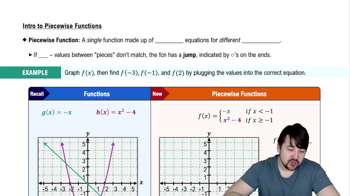
Piecewise functions are defined by different expressions based on the input value. In this problem, the function f(x) is defined differently for x ≤ 0 and x > 0. Understanding how to analyze each piece separately and how they interact at the boundary (x = 0) is essential for solving the continuity and differentiability questions posed in the problem.