2–10. General solutions Use the method of your choice to find the general solution of the following differential equations. y′(t) = (2t+1)(y²+1)
Verified step by step guidance
1
Recognize that the given differential equation is separable since it can be written as \(y'(t) = (2t+1)(y^2 + 1)\), which allows us to separate variables involving \(y\) and \(t\) on opposite sides.
Rewrite the equation in differential form as \(\frac{dy}{dt} = (2t+1)(y^2 + 1)\), then separate variables to get \(\frac{dy}{y^2 + 1} = (2t + 1) dt\).
Integrate both sides: integrate \(\int \frac{dy}{y^2 + 1}\) with respect to \(y\) and \(\int (2t + 1) dt\) with respect to \(t\).
Recall that \(\int \frac{dy}{y^2 + 1} = \arctan(y) + C_1\) and \(\int (2t + 1) dt = t^2 + t + C_2\), where \(C_1\) and \(C_2\) are constants of integration.
Combine the results to write the implicit general solution as \(\arctan(y) = t^2 + t + C\), where \(C\) is a constant that absorbs \(C_1\) and \(C_2\). Optionally, solve for \(y\) by taking the tangent of both sides to express \(y\) explicitly.
Verified video answer for a similar problem:
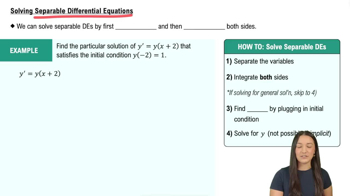
This video solution was recommended by our tutors as helpful for the problem above
Video duration:
2m
Play a video:
0 Comments
Key Concepts
Here are the essential concepts you must grasp in order to answer the question correctly.
Separable Differential Equations
A separable differential equation can be written as the product of a function of t and a function of y, allowing the variables to be separated on opposite sides of the equation. This enables integration with respect to each variable independently to find the general solution.
Solving separable equations requires integrating both sides after separation. Familiarity with integrating rational functions, polynomials, and trigonometric forms is essential to evaluate the integrals correctly and express the solution implicitly or explicitly.
The general solution includes all possible solutions and typically contains an arbitrary constant from integration. It represents a family of functions satisfying the differential equation, capturing the full set of behaviors described by the equation.