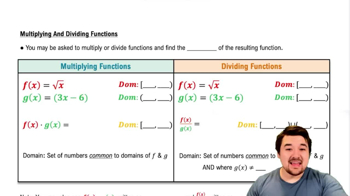
Composite functions Let ƒ(x) = x³, g (x) = sin x and h(x) = √x. Find the domain of g o ƒ.
Verified step by step guidance
1
The composition of functions \( g \circ f \) means applying function \( g \) to the result of function \( f \). In this case, \( g \circ f(x) = g(f(x)) = g(x^3) = \sin(x^3).\)
The function \( f(x) = x^3 \) is a polynomial, and polynomials are defined for all real numbers. Therefore, the domain of \( f(x) \) is all real numbers, \( (-\infty, \infty) \).
The sine function, \( \sin x \), is defined for all real numbers. Therefore, the domain of \( g(x) \) is also all real numbers, \( (-\infty, \infty) \).
Since \( f(x) = x^3 \) is defined for all real numbers and \( g(x) = \sin x \) is also defined for all real numbers, the composition \( g \circ f(x) = \sin(x^3) \) is defined for all real numbers.
The domain of \( g \circ f \) is the set of all real numbers, \( (-\infty, \infty) \), because both \( f(x) \) and \( g(x) \) are defined for all real numbers.
Verified video answer for a similar problem:
This video solution was recommended by our tutors as helpful for the problem above
Video duration:
2m
Play a video:
0 Comments
Key Concepts
Here are the essential concepts you must grasp in order to answer the question correctly.
Composite Functions
A composite function is formed when one function is applied to the result of another function. In this case, g o ƒ means we first apply the function ƒ to x, and then apply g to the result of ƒ(x). Understanding how to combine functions is essential for determining the overall behavior and properties of the composite function.
The domain of a function is the set of all possible input values (x-values) for which the function is defined. For composite functions, the domain is influenced by both the inner function and the outer function. To find the domain of g o ƒ, we must ensure that the output of ƒ(x) falls within the domain of g(x).
Different functions have specific restrictions that affect their domains. For example, the function g(x) = sin x is defined for all real numbers, while ƒ(x) = x³ is also defined for all real numbers. However, if we were to consider a function like h(x) = √x, it would impose restrictions since it is only defined for x ≥ 0. Understanding these behaviors is crucial for determining the valid inputs for composite functions.