Derivatives of hyperbolic functions Compute the following derivatives. b. d/dx (x sech x)
Verified step by step guidance
1
Identify the function to differentiate: \(f(x) = x \cdot \text{sech}(x)\), which is a product of two functions, \(x\) and \(\text{sech}(x)\).
Recall the product rule for derivatives: if \(f(x) = u(x) v(x)\), then \(f'(x) = u'(x) v(x) + u(x) v'(x)\).
Compute the derivative of the first function: \(u(x) = x\), so \(u'(x) = 1\).
Compute the derivative of the second function: \(v(x) = \text{sech}(x)\). Use the fact that \(\frac{d}{dx} \text{sech}(x) = -\text{sech}(x) \tanh(x)\).
Apply the product rule: \(f'(x) = 1 \cdot \text{sech}(x) + x \cdot (-\text{sech}(x) \tanh(x))\), then simplify the expression as needed.
Verified video answer for a similar problem:
This video solution was recommended by our tutors as helpful for the problem above
Video duration:
1m
Play a video:
0 Comments
Key Concepts
Here are the essential concepts you must grasp in order to answer the question correctly.
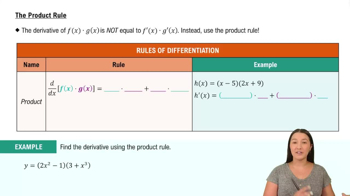
Derivative of a Product
When differentiating a product of two functions, use the product rule: (fg)' = f'g + fg'. This rule allows you to find the derivative of expressions like x·sech(x) by differentiating each part separately and combining the results.
Derivative of the Hyperbolic Secant Function (sech x)
The hyperbolic secant function, sech(x), is defined as 1/cosh(x). Its derivative is -sech(x)·tanh(x), which is essential to apply when differentiating expressions involving sech(x).
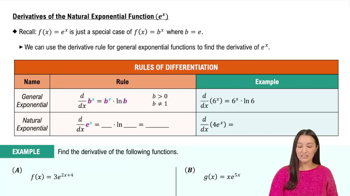
Derivative of the Natural Exponential Function (e^x)
Hyperbolic Functions and Their Properties
Hyperbolic functions like sinh, cosh, and sech have properties similar to trigonometric functions but relate to exponential functions. Understanding their definitions and relationships helps in differentiating and simplifying expressions involving them.

 1:44 minutes
 Verified step by step guidance
 05:18
05:18