When records were first kept (t=0), the population of a rural town was 250 people. During the following years, the population grew at a rate of P′(t) = 30(1+√t), where t is measured in years.
b. Find the population P(t) at any time t≥0.
Verified step by step guidance
1
Identify the given rate of change of the population, which is the derivative of the population function: \(P\'(t) = 30(1 + \sqrt{t})\).
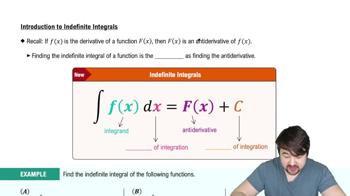
Recall that to find the population function \(P(t)\), you need to integrate the rate function \(P\'(t)\) with respect to \(t\): \(P(t) = \int P\'(t) \, dt + C\).
Set up the integral: \(P(t) = \int 30(1 + t^{1/2}) \, dt + C\).
Integrate each term separately: \(\int 30 \, dt\) and \(\int 30 t^{1/2} \, dt\).
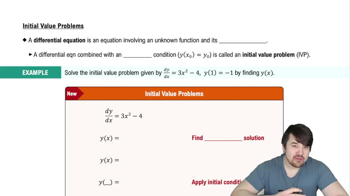
Use the initial condition \(P(0) = 250\) to solve for the constant of integration \(C\) after performing the integration.
Verified video answer for a similar problem:
This video solution was recommended by our tutors as helpful for the problem above
Video duration:
3m
Play a video:
0 Comments
Key Concepts
Here are the essential concepts you must grasp in order to answer the question correctly.
Derivative as a Rate of Change
The derivative P′(t) represents the instantaneous rate of change of the population with respect to time. Understanding that P′(t) = 30(1 + √t) means the population grows faster as time increases, and this rate function is essential for finding the original population function P(t).
To find the population function P(t) from its rate of change P′(t), we use antiderivatives or indefinite integrals. Integrating P′(t) with respect to t recovers P(t) up to a constant, which can be determined using initial conditions.
When integrating, an unknown constant appears because differentiation loses constant terms. Using the initial population P(0) = 250 allows us to solve for this constant, ensuring the population function accurately reflects the starting value.