10–12. Parametric curves a. Eliminate the parameter to obtain an equation in x and y. x = t² + 4, y = -t, for -2 < t < 0; (5, 1)
Verified step by step guidance
1
Identify the given parametric equations: \(x = t^{2} + 4\) and \(y = -t\), with the parameter \(t\) in the interval \(-2 < t < 0\).
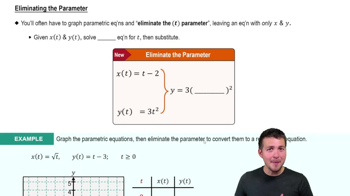
Express the parameter \(t\) in terms of \(y\) from the second equation: since \(y = -t\), then \(t = -y\).
Substitute \(t = -y\) into the first equation to eliminate the parameter: \(x = (-y)^{2} + 4\).
Simplify the expression: \(x = y^{2} + 4\).
Write the final Cartesian equation relating \(x\) and \(y\): \(x = y^{2} + 4\), which represents the curve without the parameter \(t\).
Verified video answer for a similar problem:
This video solution was recommended by our tutors as helpful for the problem above
Video duration:
1m
Play a video:
0 Comments
Key Concepts
Here are the essential concepts you must grasp in order to answer the question correctly.
Parametric Equations
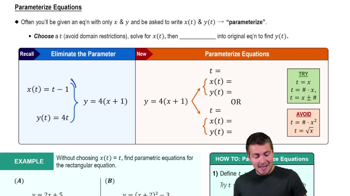
Parametric equations express the coordinates of points on a curve as functions of a parameter, often denoted as t. Instead of y as a function of x, both x and y depend on t, allowing the description of more complex curves.
Eliminating the parameter involves manipulating the parametric equations to remove t, resulting in a direct relationship between x and y. This often requires solving one equation for t and substituting into the other to find an explicit or implicit equation of the curve.
The parameter t is often restricted to a specific interval, which limits the portion of the curve described. Understanding these bounds is essential to correctly interpret the curve's segment and verify points like (5, 1) lie within the given parameter range.