A marathoner ran the 26.2-mi New York City Marathon in 2.2 hours. Show that at least twice the marathoner was running at exactly 11 mph, assuming the initial and final speeds are zero.
Verified step by step guidance
1
Recognize that this problem can be approached using the Mean Value Theorem (MVT) for integrals, which states that if a function is continuous on a closed interval, then there exists at least one point where the instantaneous rate of change (speed, in this case) equals the average rate of change over the interval.
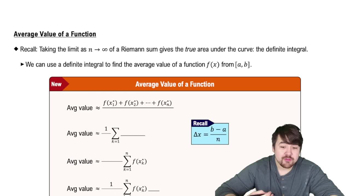
Calculate the average speed of the marathoner over the entire race. The average speed is given by the total distance divided by the total time. Here, the total distance is 26.2 miles and the total time is 2.2 hours. Therefore, the average speed is \( \frac{26.2}{2.2} \) mph.
Apply the Mean Value Theorem for integrals. Since the initial and final speeds are zero, and the speed function is continuous, there must be at least one point in time where the speed equals the average speed calculated in the previous step.
Since the problem asks to show that the marathoner was running at exactly 11 mph at least twice, note that the average speed calculated is approximately 11.91 mph. This implies that the speed must have been exactly 11 mph at least twice, as the speed function must cross this value to reach the average speed.
Conclude that by the Intermediate Value Theorem, which states that for any value between the minimum and maximum of a continuous function, there must be at least one point where the function takes that value, the marathoner must have been running at exactly 11 mph at least twice during the race.
Verified video answer for a similar problem:

This video solution was recommended by our tutors as helpful for the problem above
Video duration:
6m
Play a video:
0 Comments
Key Concepts
Here are the essential concepts you must grasp in order to answer the question correctly.
Mean Value Theorem
The Mean Value Theorem states that for a continuous function on a closed interval, there exists at least one point where the instantaneous rate of change (derivative) equals the average rate of change over the interval. In this context, it implies that the marathoner's speed must equal the average speed of 11 mph at least once during the race.
Average speed is calculated by dividing the total distance traveled by the total time taken. For the marathoner, the average speed is 26.2 miles divided by 2.2 hours, which equals 11.909 mph. This average speed helps in applying the Mean Value Theorem to find instances where the instantaneous speed matches this average.
A function is continuous if there are no breaks or jumps in its graph, and differentiable if it has a derivative at every point in its domain. The marathoner's speed function is assumed to be continuous and differentiable, allowing the application of the Mean Value Theorem to find specific speeds during the race.