Which operation can be used to eliminate the natural logarithm () from both sides of an equation such as ?
Table of contents
- 0. Functions7h 55m
- Introduction to Functions18m
- Piecewise Functions10m
- Properties of Functions9m
- Common Functions1h 8m
- Transformations5m
- Combining Functions27m
- Exponent rules32m
- Exponential Functions28m
- Logarithmic Functions24m
- Properties of Logarithms36m
- Exponential & Logarithmic Equations35m
- Introduction to Trigonometric Functions38m
- Graphs of Trigonometric Functions44m
- Trigonometric Identities47m
- Inverse Trigonometric Functions48m
- 1. Limits and Continuity2h 2m
- 2. Intro to Derivatives1h 33m
- 3. Techniques of Differentiation3h 18m
- 4. Applications of Derivatives2h 38m
- 5. Graphical Applications of Derivatives6h 2m
- 6. Derivatives of Inverse, Exponential, & Logarithmic Functions2h 37m
- 7. Antiderivatives & Indefinite Integrals1h 26m
- 8. Definite Integrals4h 44m
- 9. Graphical Applications of Integrals2h 27m
- 10. Physics Applications of Integrals 3h 16m
- 11. Integrals of Inverse, Exponential, & Logarithmic Functions2h 31m
- 12. Techniques of Integration7h 41m
- 13. Intro to Differential Equations2h 55m
- 14. Sequences & Series5h 36m
- 15. Power Series2h 19m
- 16. Parametric Equations & Polar Coordinates7h 58m
0. Functions
Exponential Functions
Problem 7.2.52
Textbook Question
"General relative growth rates Define the relative growth rate of the function f over the time interval T to be the relative change in f over an interval of length T:
R_T = [f(t + T) − f(t)] / f(t)
Show that for the exponential function y(t) = y₀ e^{kt}, the relative growth rate R_T, for fixed T, is constant for all t."
Verified step by step guidance1
Start with the given exponential function: \(y(t) = y_0 e^{k t}\), where \(y_0\) and \(k\) are constants.
Write the expression for the relative growth rate \(R_T\) over the interval \(T\) using the definition:
\(R_T = \frac{y(t + T) - y(t)}{y(t)}\).
Substitute \(y(t + T)\) and \(y(t)\) into the formula:
\(R_T = \frac{y_0 e^{k (t + T)} - y_0 e^{k t}}{y_0 e^{k t}}\).
Factor out \(y_0 e^{k t}\) from the numerator:
\(R_T = \frac{y_0 e^{k t} (e^{k T} - 1)}{y_0 e^{k t}}\).
Simplify the expression by canceling \(y_0 e^{k t}\):
\(R_T = e^{k T} - 1\). Notice that this expression depends only on \(T\) and \(k\), and not on \(t\), which shows that \(R_T\) is constant for all \(t\).
Verified video answer for a similar problem:This video solution was recommended by our tutors as helpful for the problem above
Video duration:
3mPlay a video:
0 Comments
Key Concepts
Here are the essential concepts you must grasp in order to answer the question correctly.
Relative Growth Rate
The relative growth rate measures how much a function changes relative to its current value over a time interval. It is defined as the change in the function's value divided by the original value, capturing proportional growth rather than absolute change.
Recommended video:
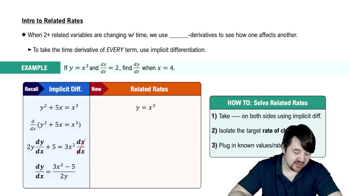
Intro To Related Rates
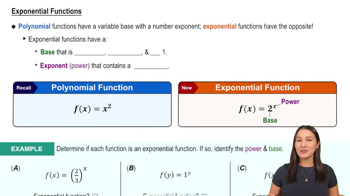
Exponential Functions
An exponential function has the form y(t) = y₀ e^{kt}, where y₀ is the initial value and k is the growth constant. Such functions model continuous growth or decay, and their rate of change is proportional to their current value.
Recommended video:
Exponential Functions
Properties of Exponential Growth
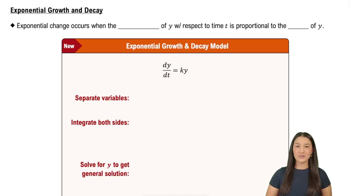
For exponential functions, the relative growth rate over any fixed interval T is constant because the ratio [y(t+T) - y(t)] / y(t) simplifies to e^{kT} - 1, which depends only on T and k, not on t. This reflects the memoryless, consistent proportional growth characteristic.
Recommended video:
Exponential Growth & Decay
Related Videos
Related Practice
Multiple Choice
128
views