Find the area of the region described in the following exercises.
The region bounded by y=e^x, y=2e^−x+1, and x=0
Verified step by step guidance
1
Step 1: Identify the boundaries of the region. The region is bounded by the curves y = e^x, y = 2e^(-x) + 1, and the vertical line x = 0. This means the region lies between these curves and starts at x = 0.
Step 2: Determine the points of intersection between the curves y = e^x and y = 2e^(-x) + 1. To find these points, set e^x = 2e^(-x) + 1 and solve for x. This will give the x-values where the two curves meet.
Step 3: Set up the integral to calculate the area. The area is found by integrating the difference between the upper curve (y = 2e^(-x) + 1) and the lower curve (y = e^x) over the interval determined by the points of intersection and x = 0.
Step 4: Write the integral expression for the area. The area can be expressed as: ∫[x=0 to x=intersection] [(2e^(-x) + 1) - e^x] dx. This represents the vertical distance between the curves integrated over the specified interval.
Step 5: Evaluate the integral. Break the integral into simpler parts if necessary, such as ∫[x=0 to x=intersection] 2e^(-x) dx, ∫[x=0 to x=intersection] 1 dx, and ∫[x=0 to x=intersection] e^x dx. Compute each part and combine the results to find the total area.
Verified video answer for a similar problem:
This video solution was recommended by our tutors as helpful for the problem above
Video duration:
7m
Play a video:
0 Comments
Key Concepts
Here are the essential concepts you must grasp in order to answer the question correctly.
Definite Integrals
Definite integrals are used to calculate the area under a curve between two points on the x-axis. In this context, the area between the curves y=e^x and y=2e^−x+1 can be found by integrating the difference of these functions over the appropriate interval. The limits of integration will be determined by the points where the curves intersect.
Finding the intersection points of the curves y=e^x and y=2e^−x+1 is essential for determining the limits of integration. This involves setting the two equations equal to each other and solving for x. The x-values at which the curves intersect will define the boundaries of the area to be calculated.
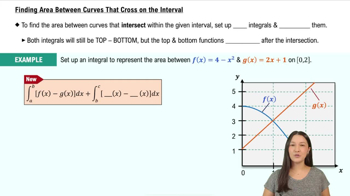
Finding Area Between Curves that Cross on the Interval
Exponential Functions
Exponential functions, such as y=e^x and y=2e^−x+1, are characterized by their rapid growth or decay. Understanding their behavior is crucial for analyzing the region they enclose. The function e^x increases without bound as x increases, while 2e^−x+1 approaches 1 as x increases, creating a bounded area between them.

 7:43 minutes
 Verified step by step guidance

 05:43
05:43