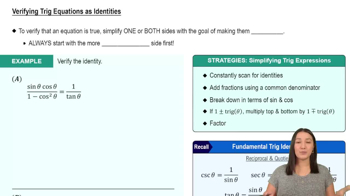
Recognize that the limit involves the function tan(2x), which can be rewritten using the identity tan(2x) = sin(2x) / cos(2x). This gives us the expression lim(x→0) (sin(2x) / (x * cos(2x))).
To simplify the expression, focus on the term sin(2x) / x. Notice that this can be rewritten as (sin(2x) / 2x) * (2x / x).
Apply the limit property lim(θ→0) (sin(θ) / θ) = 1 to the term (sin(2x) / 2x). This implies that as x approaches 0, (sin(2x) / 2x) approaches 1.
Now, consider the term (2x / x), which simplifies to 2. Therefore, the expression (sin(2x) / x) simplifies to 2 * (sin(2x) / 2x).
Finally, evaluate the limit of the entire expression: lim(x→0) (2 * (sin(2x) / 2x) / cos(2x)). Since (sin(2x) / 2x) approaches 1 and cos(2x) approaches cos(0) = 1 as x approaches 0, the limit simplifies to 2 * 1 / 1.
Verified video answer for a similar problem:
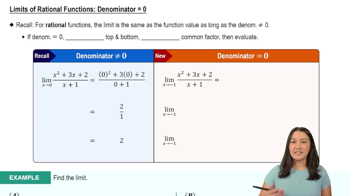
This video solution was recommended by our tutors as helpful for the problem above
Video duration:
1m
Play a video:
0 Comments
Key Concepts
Here are the essential concepts you must grasp in order to answer the question correctly.
Limit of a Function
The limit of a function describes the behavior of the function as the input approaches a certain value. In calculus, understanding limits is crucial for analyzing how functions behave near specific points, which is foundational for defining derivatives and integrals. The limit limθ→0 sin θ / θ = 1 is a standard result used to evaluate limits involving trigonometric functions.
Trigonometric identities are equations involving trigonometric functions that are true for all values of the variables involved. They are essential tools for simplifying expressions and solving problems in calculus. For example, the identity tan x = sin x / cos x can be used to rewrite and simplify the expression tan 2x in terms of sine and cosine, aiding in the evaluation of limits.
L'Hôpital's Rule is a method for finding limits of indeterminate forms, such as 0/0 or ∞/∞. It states that if the limit of f(x)/g(x) as x approaches a point results in an indeterminate form, the limit can be found by differentiating the numerator and denominator separately. This rule is particularly useful for evaluating limits involving complex expressions, such as limx→0 (tan 2x) / x.