In Exercises 7 and 8, which of the graphs are graphs of functions of x, and which are not? Give reasons for your answers.
b. <IMAGE>
Verified step by step guidance
1
Step 1: Understand the definition of a function. A function is a relation between a set of inputs and a set of permissible outputs with the property that each input is related to exactly one output.
Step 2: Use the Vertical Line Test to determine if a graph represents a function. The Vertical Line Test states that a graph represents a function if and only if no vertical line intersects the graph at more than one point.
Step 3: Examine the given graph (represented by ) and imagine drawing vertical lines across the entire graph.
Step 4: Check if any vertical line intersects the graph at more than one point. If it does, the graph is not a function of x. If every vertical line intersects the graph at most once, then it is a function of x.
Step 5: Provide a reasoned conclusion based on the Vertical Line Test. If the graph passes the test, state that it is a function of x. If it fails, explain that it is not a function of x because there exists at least one vertical line that intersects the graph at more than one point.
Verified video answer for a similar problem:
This video solution was recommended by our tutors as helpful for the problem above
Video duration:
3m
Play a video:
0 Comments
Key Concepts
Here are the essential concepts you must grasp in order to answer the question correctly.
Definition of a Function
A function is a relation between a set of inputs and a set of possible outputs where each input is related to exactly one output. This means that for every x-value in the domain, there is a unique y-value in the range. Understanding this definition is crucial for determining whether a given graph represents a function.
The vertical line test is a method used to determine if a graph represents a function. If any vertical line drawn through the graph intersects it at more than one point, the graph does not represent a function. This test provides a visual way to assess the uniqueness of outputs for each input.
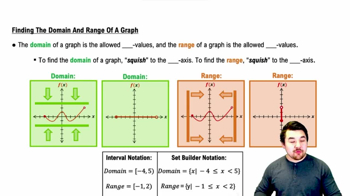
The domain of a function is the set of all possible input values (x-values), while the range is the set of all possible output values (y-values). Understanding the domain and range helps in analyzing the behavior of functions and is essential for identifying whether a graph meets the criteria of a function.

 3:06 minutes
 Verified step by step guidance

 05:43
05:43